Our work is entirely funded by private donations – we receive no money from government. Your money will help us continue funding research into vitiligo and supporting people affected by the condition.
Frequently Asked Questions
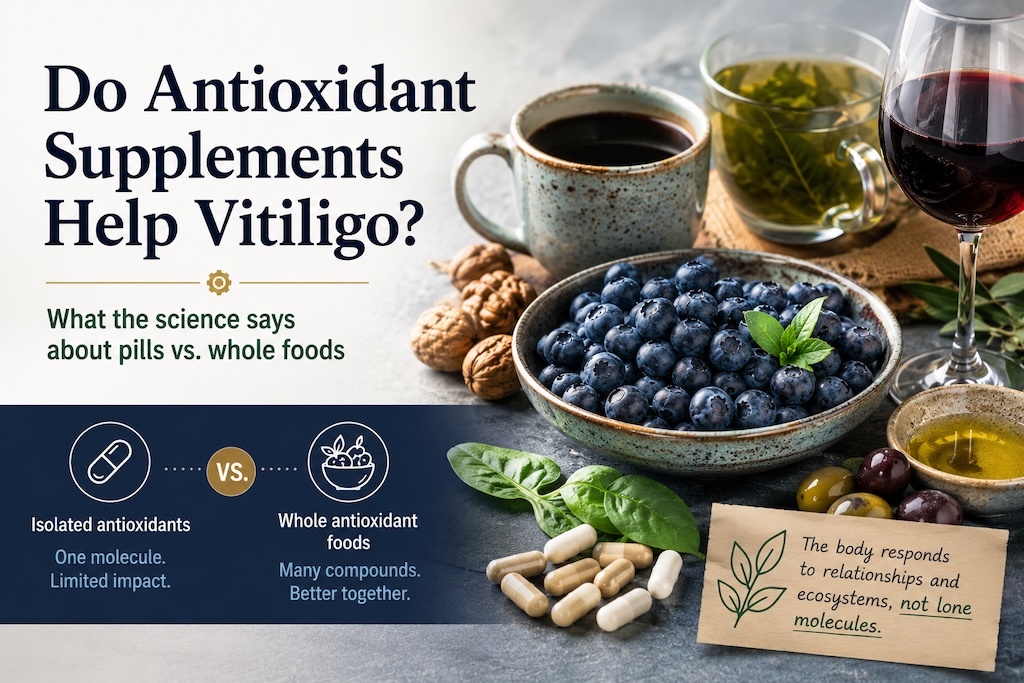
Do Antioxidant Supplements Help Vitiligo?
Do Antioxidant Supplements Help Vitiligo?
Short answer
Maybe a little. But probably not in the way most people hope. Antioxidant supplements may offer modest support, especially with Narrowband UVB phototherapy, but no antioxidant pill has been shown to reliably restore pigment or change vitiligo on its own.
Why doesn’t the logic work?
The theory sounds simple: vitiligo involves oxidative stress, antioxidants reduce oxidative stress, so antioxidant supplements should help vitiligo.
Unfortunately, biology did not receive this memo.
The body usually responds to complex networks, not single molecules. A blueberry contains hundreds of interacting compounds. Coffee contains more than a thousand bioactive substances. These affect inflammation, metabolism, blood vessels, gut bacteria, and cellular signaling at the same time.
A supplement usually brings one or two isolated compounds. It’s a bit like removing one gear from a Swiss watch and expecting it to keep perfect time.
Which antioxidants have been studied?
Researchers have studied vitamin C, vitamin E, alpha-lipoic acid, CoQ10, ginkgo biloba, Polypodium leucotomos, selenium, zinc, resveratrol, and various plant-derived polyphenols.
Some studies report small improvements, especially when antioxidants are used alongside phototherapy. But no single antioxidant has become a widely accepted, strongly proven treatment for vitiligo.
What does recent research suggest?
Some of the most interesting evidence comes from genetic studies known as Mendelian randomization analyses. These studies found that genetically predicted intake of coffee, tea, and moderate red wine was associated with lower vitiligo risk.
But genetically predicted circulating levels of isolated antioxidants — including vitamin C, vitamin E, selenium, zinc, and carotenoids — did not show meaningful protection.
In plain English: the body appeared to respond to antioxidant-rich dietary patterns, but not to isolated antioxidant molecules floating alone in the bloodstream.
Should I take antioxidant supplements anyway?
Possibly, but expectations should stay realistic.
Antioxidants may be worth discussing with your healthcare provider if you have a documented nutritional deficiency, are undergoing phototherapy, or have another medical reason to take a specific supplement.
They should be viewed as supportive measures, not primary vitiligo treatments.
Are antioxidant supplements dangerous?
Most standard antioxidant supplements are relatively safe at recommended doses. But “more” is not always better.
Very high doses may interfere with normal cellular signaling, affect medications, cause digestive side effects, or create unexpected interactions with other supplements.
Megadosing without medical supervision is usually not a great idea. Biology is complicated enough without turning your bloodstream into a chemistry experiment.
What about getting antioxidants from food?
This is where the evidence becomes more encouraging.
Foods naturally rich in antioxidant and polyphenol compounds may support healthier inflammatory balance and metabolic function while also providing things supplements cannot easily replicate: fiber, minerals, healthy fats, plant compounds, and slower absorption.
Good examples include coffee, blueberries and other berries, green tea, olive oil, nuts, legumes, colorful vegetables, and whole grains.
Bottom line
Oxidative stress matters in vitiligo, but antioxidant supplements have not lived up to the early hype.
Some may provide modest benefit, especially with phototherapy, but no antioxidant pill has been shown to consistently reverse vitiligo or dramatically improve outcomes on its own.
The gear matters. But the watch only works when the whole mechanism stays intact.
Disclaimer: This information is provided for educational purposes only and is not a substitute for medical advice, diagnosis, or treatment. Vitiligo response to therapy varies widely from person to person. Patients should discuss treatment options, expected outcomes, and any concerns with a qualified dermatologist or other licensed healthcare professional.
Related reading
Why Coffee Works Better Than Capsules: The Antioxidant Puzzle in Vitiligo
A deeper look at why whole antioxidant-rich foods may support the body better than isolated antioxidant pills.
FAQOther Questions
- Белые пятна на теле? Витилиго?
Гид по Витилиго — ваш компас в лабиринте загадочной болезни и непростых решений. Здесь всё по-честному, по делу и на понятном языке. Вы найдёте здесь: Объяснения, что происходи...
- Will it spread?
Vitiligo is famously unpredictable, but it doesn't move at random. By looking at thousands of cases, researchers have identified specific patterns of how the condition behaves. ...
- Does vitiligo increase the risk of skin cancer?
No, it does not. Despite common misconceptions, people with vitiligo are actually at a lower risk of developing skin cancer—including both nonmelanoma skin cancer (NMSC) and mal...
Though it is not always easy to treat vitiligo, there is much to be gained by clearly understanding the diagnosis, the future implications, treatment options and their outcomes.
Many people deal with vitiligo while remaining in the public eye, maintaining a positive outlook, and having a successful career.
Copyright (C) Bodolóczki JúliaBy taking a little time to fill in the anonymous questionnaire, you can help researchers better understand and fight vitiligo.