


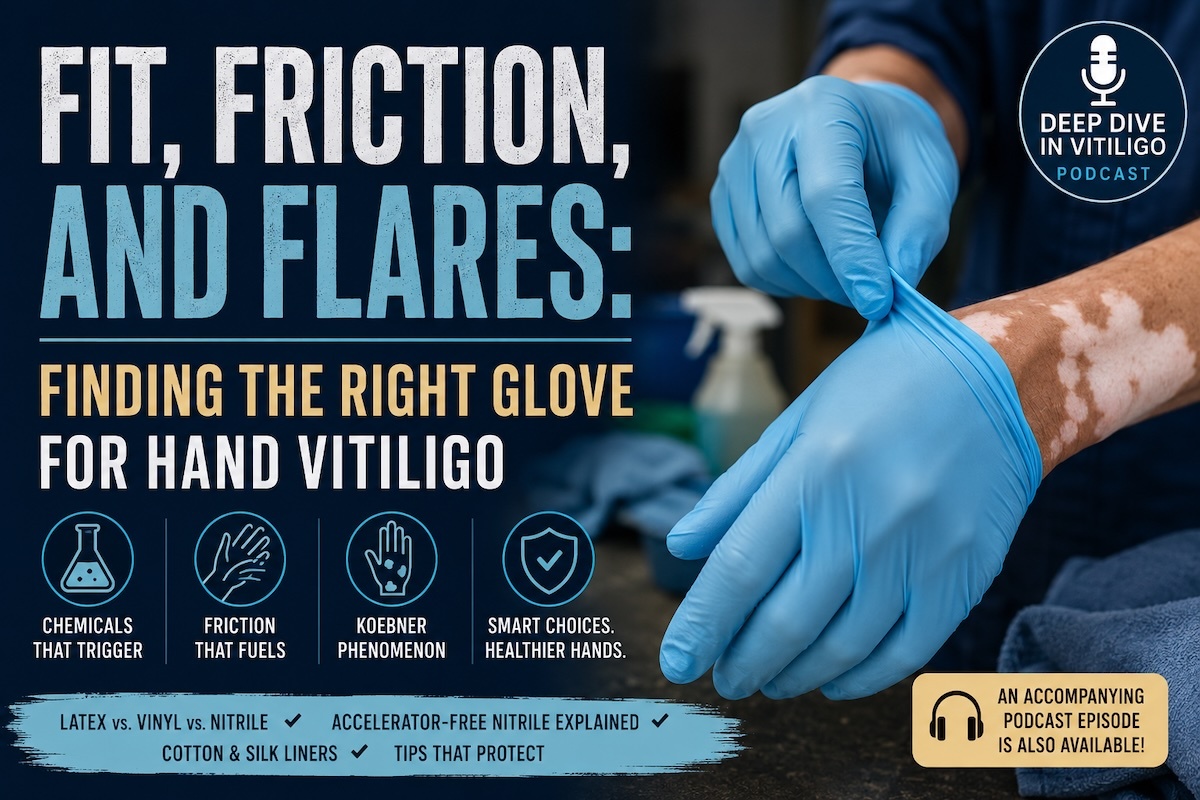
Prefer listening?
An accompanying episode of Deep Dive in Vitiligo is also available for readers who would rather listen than spend quality time thinking about glove chemistry.
Fit, Friction, and Flares: Finding the Right Glove for Hand Vitiligo
Why gloves can affect vitiligo
There is a well-described phenomenon called chemically induced depigmentation, also known as contact leukoderma. Certain chemicals, with repeated contact, can lead to persistent whitening of the skin—first at the contact site, and sometimes beyond it.
More commonly, gloves can trigger contact dermatitis. In modern workplaces, glove-induced dermatitis is far more common than true chemical leukoderma. Most people with vitiligo are dealing with irritation, allergy, sweat, and friction rather than direct melanocyte toxicity from the glove itself.
Dermatitis weakens the skin barrier, ramps up inflammation, and makes the skin more reactive. On that background, new vitiligo spots can appear more easily in some people.
Latex and rubber gloves: often the riskiest option
Why these are often avoided in people with vitiligo on the hands:
- Rubber and latex products frequently contain vulcanization accelerators. The usual suspects include thiurams, carbamates, and mercapto-compounds, including mercaptobenzothiazole, or MBT. These are common triggers of allergic contact dermatitis.
- Some rubber products may contain phenolic compounds and related chemicals. This chemical family has a long history of being linked to persistent depigmentation after repeated exposure.
A simple real-world rule: if gloves reliably cause itching, dryness, cracks, burning, or redness, latex/rubber is rarely your best long-term plan. Also, “it used to be fine” does not guarantee “it will stay fine.” Hands can change their mind.
Vinyl (PVC) gloves: a compromise, not a magic shield
Why people pick vinyl:
- no latex
- often fewer classic rubber accelerators
- cheap and widely available
Where the catch can be:
PVC gloves can contain traces of various additives, including potential allergens and plasticizers. Important: most people tolerate vinyl just fine. The warning is mainly for those whose hands are already inflamed, hyper-reactive, or stuck in a chronic dermatitis loop.
Another practical issue: vinyl often tears more easily. That means more friction, more micro-trauma, and direct contact with whatever you were trying to avoid in the first place.
When vinyl can make sense: short, low-risk tasks, especially if you have no history of vinyl-related irritation.
Nitrile gloves: usually the best starting point
Nitrile is popular for a reason: it is latex-free, often more durable than vinyl, and generally holds up well for many household and workplace exposures. But there is one detail many people miss.
Nitrile is not one thing: standard vs accelerator-free
Standard nitrile gloves may still contain chemical accelerators, the same families that can trigger allergic contact dermatitis. So you can get the frustrating situation: “I avoided latex, switched to nitrile… and my hands still freak out.”
The simplest fix is to look for accelerator-free nitrile gloves. Over the past decade, many hospitals and occupational health programs have increasingly adopted accelerator-free nitrile gloves because rubber accelerators remain one of the most common causes of glove-related allergic contact dermatitis. If your hands are already sensitive, this is usually where the search should begin.
Examples of accelerator-free nitrile brands: Ansell Micro-Touch, Tronex, Medline SensiCare. Note: we do not receive compensation for mentioning these brands, and glove formulations can change, so always check the current product specifications.
How to choose gloves without making your hands hate you
- If you wear gloves often: accelerator-free nitrile is the default choice.
- If the task is short and low-risk: vinyl can be acceptable if your skin tolerates it.
- If you have vitiligo on the hands and especially recurring dermatitis: latex/standard rubber is more likely to cause trouble.
Small details that matter more than the material
Fit matters
Gloves that are too tight = friction + heat + sweat. That is basically a Koebner starter kit. Pick a size that lets your fingers move freely without the glove flopping around.
Skip the powder
Powder can irritate and dry the skin, especially if your hands are already temperamental.
Take breaks
Gloves are a mini-sauna. Long uninterrupted wear macerates the skin and weakens the barrier. If you work for a while, take short breaks, let your hands dry, then continue.
Consider a cotton or silk liner
If you must wear gloves for long periods, or your hands are already inflamed, thin cotton gloves under the protective glove can reduce sweat and friction.
Some dermatologists also recommend pure silk glove liners for severe hand dermatitis. Silk creates even less friction than cotton and tends to absorb less of the skin’s natural moisture, making it a reasonable option for particularly sensitive hands.
Do not trust the label too quickly
Many newer nitrile gloves are marketed as “eco-friendly” or “biodegradable.” That may be good news for landfills, but it does not automatically mean the gloves are accelerator-free. Always check the manufacturer’s specifications rather than assuming environmental claims equal skin-friendly chemistry.
Do the boring aftercare
After work: gentle wash, pat dry, do not rub, then a solid moisturizer. Boring. Effective.
In fact, the best glove is often paired with the best moisturizer. An intact skin barrier reduces irritation, dermatitis, and the kind of chronic skin stress that can contribute to Koebnerization.
When to involve a dermatologist and patch testing
If you notice any of the following:
- itching, burning, redness after wearing gloves
- new cracks/dryness that “suddenly started”
- new white patches that match the glove contact zones
- worsening of existing hand lesions
This is not the moment to guess your way through forums. Patch testing can identify the specific culprit, so you are not forced into endless brand roulette.
Common patch-test targets when gloves are the suspected trigger:
- thiuram mix, accelerators
- carba mix, accelerators
- mercapto mix / MBT, accelerators
- sometimes specific additives, depending on the glove composition
A quick word on the Koebner phenomenon
Koebner means new lesions can appear at sites of repeated irritation, friction, or minor trauma. Gloves can provoke Koebner not only through chemicals, but through pure mechanics: tight fit, sweat, heat, rubbing.
So “the right glove” is not just material. It is also fit, wear time, breaks, and minimizing micro-trauma.
Bottom line
If you need a “daily driver” glove for vitiligo on the hands, the most predictable choice is usually accelerator-free nitrile. Vinyl can be a short-task compromise. Latex/standard rubber more often cause issues due to additives, especially if you already struggle with hand dermatitis.
Your skin is not a lab for “maybe it’ll be fine.” Let gloves protect your hands, not give them extra work.
P.S. If you work with harsh chemicals, even the friendliest gloves should be replaced every 30–40 minutes. No material maintains a perfect barrier forever.
Quick comparison table
| Material | Skin risk | Who it fits best | Best use cases |
|---|---|---|---|
| Latex / rubber | High, often due to additives; higher dermatitis risk, possible chemical depigmentation risk with certain compounds | Usually not ideal for vitiligo on the hands, especially with hand dermatitis | Only short, unavoidable use, with close attention to skin reactions |
| Vinyl (PVC) | Moderate; often tolerated, but can irritate very reactive or inflamed skin; tears more easily | People who tolerate vinyl and need short, low-risk protection | Short household tasks, light-duty work, low chemical exposure |
| Nitrile, standard | Low to moderate; some may react to accelerators | Many people as a main option if there is no dermatitis trigger | Regular work, household chemicals, many professional tasks |
| Nitrile, accelerator-free | Low; most predictable for sensitive skin | Vitiligo on hands, sensitive skin, recurrent hand dermatitis, allergy-prone skin | Daily use, longer wear, work with irritants, with breaks and timed replacement |
Two “just tell me what to do” scenarios
Scenario 1: home cleaning, kitchen, everyday products
- 10–15 minutes, mild products: vinyl can be fine.
- Longer, frequent cleaning: accelerator-free nitrile.
- If hands are already irritated: cotton or silk liner under nitrile + breaks.
- After: pat dry, moisturize.
Scenario 2: hands-on work: repairs, auto work, medical, salon, hair
- Default: accelerator-free nitrile.
- If there is lots of sweat/friction: cotton or silk liner + more frequent glove changes.
- With dyes, disinfectants, solvents: replace every 30–40 minutes. Do not “push through.”
- If redness/itching appears repeatedly: pause, reassess, consider patch testing.
Small decisions compound into better skin health. This is one of them.
Choose wisely. And now you know exactly what to look for.

Yan Valle
Prof. h.c., CEO VRF | Author of “A No-Nonsense Guide To Vitiligo”