

New

15 Years of Vitiligo News Publication
15 Years of Vitiligo News Publication
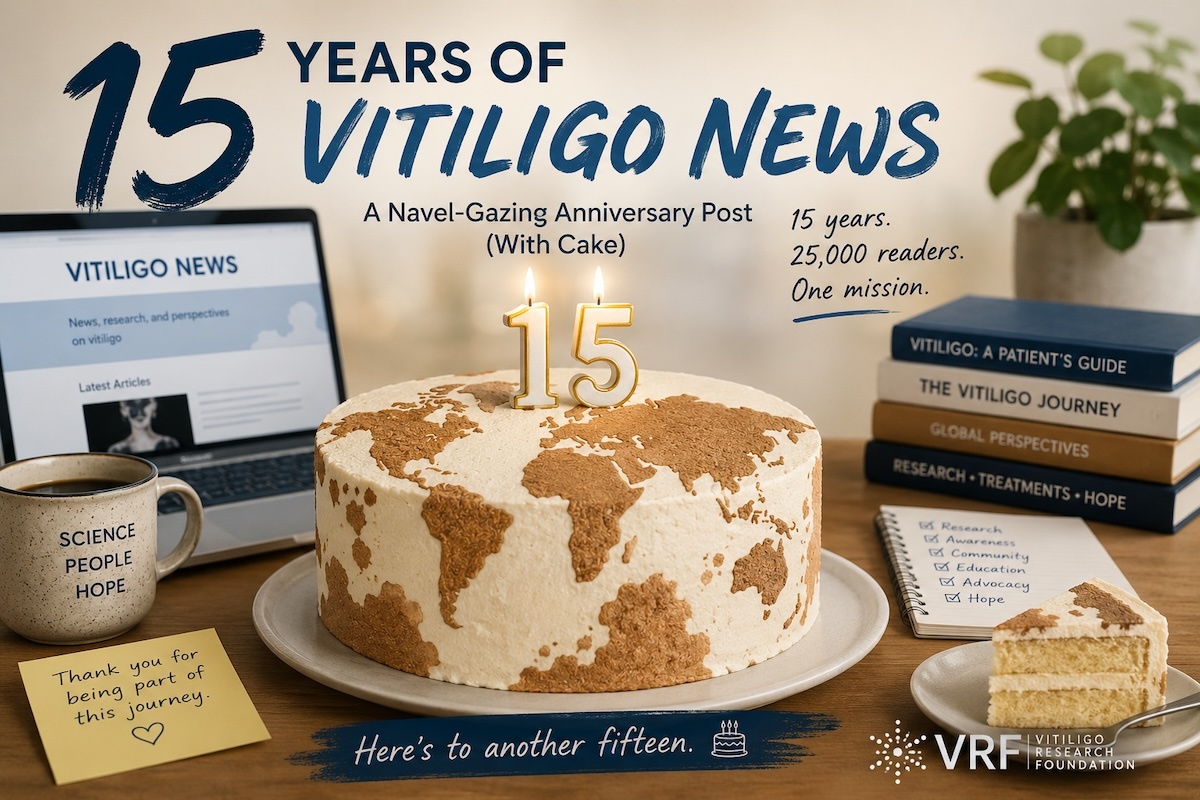
Today marks the 15th anniversary of Vitiligo News.
That feels big enough to justify a little reflection — and definitely a slice of cake.
The title started as self-deprecating humor. Back in 2012, not much seemed to be happening in the vitiligo world, and I genuinely thought I would write only occasionally. That first year proved me right. The posts were sporadic, the audience was small, and there was no grand strategy behind any of it.
Fifteen years later, I still cannot decide whether this is a blog or a newsletter.
The distinction seems increasingly irrelevant. Most longer articles now live in the News section of the VRF website, while the newsletter serves more as a guidepost: a short introduction, a few observations, and an invitation to read further if something catches your interest.
The Strange Little Audience That Grew
What surprises me most is that so many people decided to come along for the ride.
Today, roughly 25,000 readers receive these updates. That is far more than the Vitiligo Research Foundation ever imagined when we started. We periodically remove inactive subscribers to keep costs manageable, but the growth has nonetheless been remarkable: roughly one thousand readers during the first year, steady growth for more than a decade, and only recently signs that we may be approaching a plateau.
The readership itself is an unusual mix.
Roughly one-third of subscribers identify themselves as researchers and physicians, with a fairly blurry line between those two groups. Another third comes from the patient community — people living with vitiligo, parents, family members, advocates, and support group leaders.
A Slightly Suspicious Academic Existence
That unusual mix has created a slightly unusual academic existence for me.
Some colleagues subscribe and assume I am remarkably productive. Others have no idea this publication exists and probably assume I stopped publishing years ago.
To be fair, both groups have a point.
I still believe in peer review. I still publish occasionally. Quite conveniently, academic publishing decided to remind me of this during the anniversary.
Three recent opinion papers look at vitiligo treatment from different directions: systemic treatment for active disease, home-based phototherapy and treatment delivery, and the therapeutic objectives of vitiligo care itself.
The practical question is simple: how do we turn what we already know into effective, accessible, routine care?
I still do not believe every worthwhile idea needs to spend a year winding its way through the publication process before seeing daylight. Ironically, AI has only strengthened that conviction. If a publishable-looking paper can now be assembled in hours rather than months, the real value of scholarship increasingly lies in having an idea worth discussing in the first place.
That is one reason this publication has become more important to me over time, not less.
A Running Record of a Changing Field
It has also been fascinating to watch the vitiligo field evolve.
When this newsletter started, there were no approved treatments for vitiligo. Public awareness was limited. Social media communities were still emerging. World Vitiligo Day was in its infancy. Artificial intelligence was still mostly science fiction — or at least something that lived safely inside conference panels and bad movie scripts.
Today, we have approved therapies, active clinical development programs, global patient communities, AI-powered support tools, and a level of public visibility that would have seemed almost unimaginable fifteen years ago.
In many ways, this publication became a running record of that transformation.
What Comes Next
Looking ahead, I plan to continue doing what I have always done: documenting the vitiligo world, highlighting new voices, following the science, exploring the growing role of AI in healthcare, and occasionally using these pages to think out loud about where all of this might be heading next.
I have no particular business model. No grand media ambitions. No secret plan.
I write because I enjoy it.
I enjoy following the science. I enjoy watching the field evolve. I enjoy connecting ideas that do not normally get connected. And every once in a while, I enjoy writing something that makes people stop and think.
Thank you, as always, for reading.
If nothing else, I can say with certainty that writing this publication over the past fifteen years has been good for me.
Here's to another fifteen years. Have some cake 🎂
CEO, Vitiligo Research Foundation
Connect
If you would like to follow more reflections on vitiligo, AI, healthcare, patient advocacy, and the occasional institutional absurdity, you can connect with me on LinkedIn.
Suggested Reading
🎙 Listen to Deep Dive in Vitiligo
For readers who prefer to listen rather than scroll, a few related episodes:
AI Now Speaks the Language of Cells (Ep. 40)
The Great AI Debate: Do AI Models Truly “Get” It? (Ep. 26)
FAQOther Questions
- What is the best therapy for localized vitiligo?
Localized vitiligo, where the white patches are limited to one or a few areas of the body, can be managed with a few treatment approaches. The best therapy usually depends on th...
- What are rules for military service entry with vitiligo?
Military service · Patient guide How do military-service rules for vitiligo differ across countries? There is no global standard. Every country writes its own entry rules, and m...
- How to get insurance coverage for vitiligo treatments?
Getting insurance coverage for vitiligo treatments can be challenging, but there are several steps you can take to improve your chances For a more in-depth look, check out our u...
Though it is not always easy to treat vitiligo, there is much to be gained by clearly understanding the diagnosis, the future implications, treatment options and their outcomes.
Many people deal with vitiligo while remaining in the public eye, maintaining a positive outlook, and having a successful career.
Copyright (C) Bodolóczki JúliaBy taking a little time to fill in the anonymous questionnaire, you can help researchers better understand and fight vitiligo.