

New

Career Success with Visible Vitiligo
Interview Tips and Workplace Rights
Visible vitiligo throws an extra, unasked-for variable into professional life. Not because it changes your competence — it doesn’t — but because humans are visual first and rational second. First impressions matter, “client-facing” gets weaponized, and unconscious bias sometimes shows up like that one colleague who stares a beat too long.
Here’s the good news. The research is clear that visibility can affect work experiences, especially when the face is involved. But that is a social problem, not a skills problem. And social problems need strategy, boundaries, and sometimes a little documentation. The glamorous stuff, obviously.
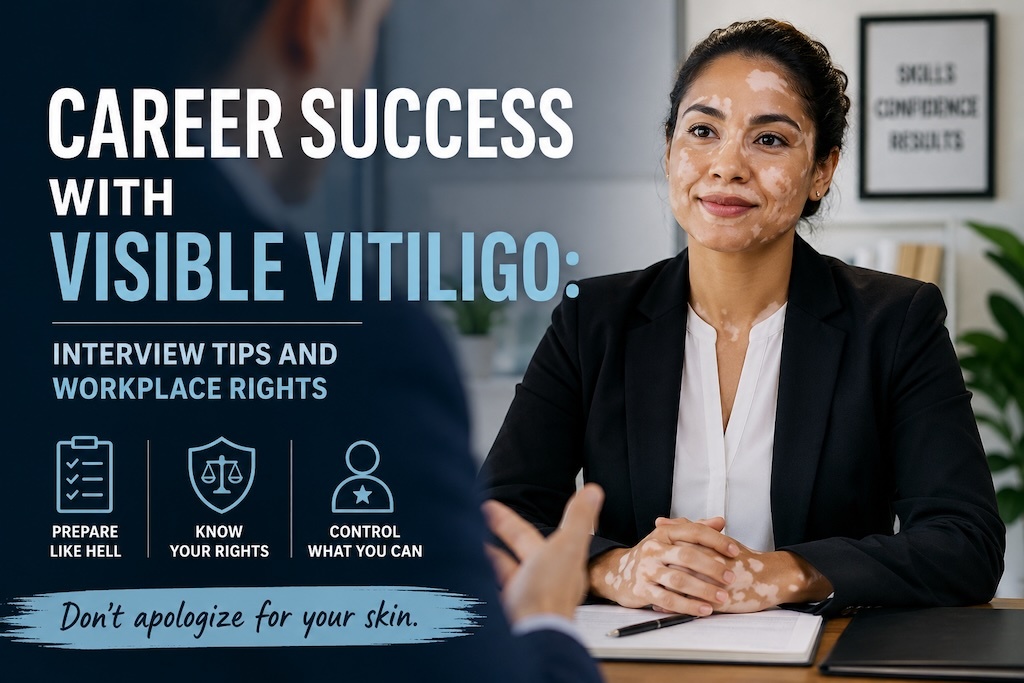
Your skin may enter the room first. Your job is to make sure your work takes over the conversation.
In brief
Visible vitiligo can affect interviews, promotion, confidence, and workplace comfort. That does not mean it defines your career. Prepare hard. Bring evidence. Know your rights. Set boundaries. And don’t apologize for your skin.
The workplace reality
Let’s not sugarcoat it. Appearance-based bias exists in hiring and promotion. When vitiligo affects visible areas, especially the face, it can change how people judge “professionalism,” even when the job has nothing to do with skin.
A 2025 paper on major life-changing decisions in vitiligo found that facial involvement was linked to greater reported impact in professional areas, including career choice, job performance, promotion opportunities, and income. That is not “in your head.” That is data doing its annoying little tap dance.
Another real-world US survey found measurable work impairment among people with nonsegmental vitiligo, with higher burden when the face was involved. This matters because the emotional load is part of the workday too. Not weakness. Cost.
But bias does not win by default. It wins when people treat it as fate. Your goal is simple: make competence the loudest thing in the room, and know what protections exist if someone tries to make your skin the story.
Workplace rights and protections
Quick disclaimer: this is education, not legal advice. Laws differ by country, state, province, and workplace context. If you are dealing with a specific situation, speak with a qualified employment lawyer, worker rights organization, or official agency in your area.
Is vitiligo a disability?
Not automatically. But it can be treated as a disability under some laws depending on the impact, context, and how you are treated by others.
In the United States, the ADA can protect people with physical or mental impairments that substantially limit major life activities, people with a record of such impairment, or people regarded as having such impairment. Major life activities can include major bodily functions, including functions of the skin.
In the United Kingdom, the Equality Act 2010 protects people whose condition has a substantial and long-term adverse effect on normal day-to-day activities. ACAS also notes that severe disfigurement is usually treated as having such an effect under the law, even without proving day-to-day limitation. This may be relevant for some people with visible skin differences, though individual cases still matter.
What protections may apply
In the US, employers generally may not ask disability-related questions or require medical exams before making a job offer. They can ask whether you can perform essential job duties. They may also need to provide reasonable accommodations when needed, unless doing so creates undue hardship.
In the UK, employers have a duty to make reasonable adjustments for disabled employees, and discrimination protections can apply across recruitment, employment terms, promotion, and dismissal.
VA benefits for US veterans
If you are a US veteran with service-connected vitiligo, the VA rating schedule includes vitiligo under Diagnostic Code 7823. The current schedule lists a 10% rating when exposed areas are affected and 0% when no exposed areas are affected. The exact outcome depends on your case and documentation.
Interview strategy that actually works
Most interview advice is fluff. “Be confident.” “Smile.” “Tell your story.” Fine. Lovely. Put it on a mug.
The practical version is this: you want the interviewer thinking about your results, not your pigmentation.
Build a case, not a vibe
Go in with a tight professional narrative: what you do, what you have done, and what you can do for them. Practice until it sounds like a human talking, not a hostage reading LinkedIn poetry.
Bring proof. Portfolio. Metrics. Outcomes. Testimonials. Before-and-after project summaries. Whatever fits your field. Bias thrives in ambiguity. Evidence kills ambiguity.
Also do a culture scan. Look for signs that the company actually practices inclusion, not just prints it on a recruiting slide. Employee resource groups, transparent HR policies, leadership diversity, and how they speak about customers and teams can tell you a lot.
The camouflage question
Should you cover your patches for an interview? There is no universal answer, and nobody gets to police your choice.
If covering makes you calmer and more focused, it can be a useful tool. If covering makes you feel like you are playing a role you will have to maintain forever, it can backfire. The best rule is boring but true: choose the version of you that interviews best. Not the version that “should” exist.
In the room
Your job in the first 60 seconds is to set the tone. Warm greeting. Steady eye contact. Calm pace. You are not asking permission to be there. You are evaluating them too.
If you sense distraction — staring, awkwardness, that little human software glitch — you can ignore it and keep moving. Often that is enough.
If the awkwardness is loud, a short, matter-of-fact line can clear the air:
“By the way, I have vitiligo. It’s a non-contagious skin condition that affects pigment only. It doesn’t affect my ability to do the job. Happy to answer a quick question if helpful. Now, about your goals for this role…”
Then pivot. Always pivot. You are not there to run a dermatology seminar.
When someone asks something inappropriate
In the US, employers generally cannot ask disability-related questions before making a job offer, even when a disability is obvious. They can ask whether you can perform job duties. They can ask you to describe or demonstrate how you would do them. But medical interrogation is not the point of the interview.
If someone asks, “What’s wrong with your skin?” you have a few clean options:
Short and redirect:
“It’s vitiligo. It’s not contagious and it doesn’t affect my work. What matters for this role is my experience with X.”
Boundary and clarity:
“I keep medical topics private at work, but I can reassure you it doesn’t affect job performance.”
Professional mirror:
“Are you asking because you have concerns about essential job functions? I’m fully able to perform them.”
If the interaction feels discriminatory, document it right after. Date, time, who said what, who witnessed it. Memory fades. Notes don’t.
Disclosure: when to say something, and when not to
You do not owe a disclosure just because vitiligo is visible. You are allowed to be a person at work, not a walking FAQ with shoes.
Disclosure can help when you need accommodations, such as appointments, phototherapy schedules, protective clothing, flexible hours, or time away for treatment. It can also help when you want to control the narrative instead of letting curiosity fill the gap with nonsense.
But if you do not need accommodations and prefer privacy, you can simply do your job. People usually adjust faster than we fear.
If you do disclose, keep it boring and brief:
“I have vitiligo. It affects pigment only. It doesn’t affect my work. If you notice it, that’s what it is.”
Done. No TED Talk required.
Thriving after you’re hired
The best protection against bias is competence plus visibility on your terms.
Deliver strong work early. Build allies across teams. Volunteer for projects that put your expertise in public view. Keep a private “wins” document: outcomes, praise, metrics, emails, reviews.
Not because you are paranoid. Because workplaces have selective memory, and your future self will thank you.
For day-to-day comments and curiosity, boundaries are allowed. You can be polite and still end the conversation:
“Totally fair question, but I don’t discuss health stuff at work. Anyway, about the project…”
If you suspect discrimination
Look for patterns. One awkward person is annoying. A repeated pattern that affects pay, promotion, assignments, reviews, scheduling, or client exposure is a workplace problem.
Document specifics. Save emails. Write down dates and witnesses. If you are comfortable, raise it through the company process: manager, HR, ethics line, or formal complaint route.
If that goes nowhere, consider outside help, such as an employment lawyer, worker rights organization, union representative, or official agency like the EEOC in the US.
Also remember: you are allowed to leave. Staying in a place that turns your skin into a permanent stress test is not “resilience.” It is just stress wearing a cheap suit.
Visibility and role models
Some people with vitiligo go public and become advocates. Some don’t. Both are valid.
If you want proof that visible vitiligo can coexist with high-performance careers, you do not have to look far. Winnie Harlow built an international modeling career while openly discussing vitiligo. Lee Thomas, a TV host and journalist, has used his platform to educate calmly and practically. Justin Sacksner has written about how vitiligo shaped his path toward medicine.
There are also many public figures who are widely reported to have vitiligo across film, television, music, politics, sports, business, and art. A quick caveat for honesty: some have spoken openly about it, while others are reported in public sources. Either way, the pattern is the same: visibility does not cancel competence.
Your career does not need to be a statement. But if it becomes one, it can help the next person walk into an interview without feeling like they have to apologize for their skin existing.
Closing thoughts
Vitiligo can change how people look at you. It does not change what you can do.
Your playbook is straightforward: prepare hard, bring evidence, keep your story professional, set boundaries when needed, and know your rights when someone crosses the line.
Bias exists. So do receipts, documentation, and laws.
And on the days when confidence is low, borrow a simple truth: the right employer is not “doing you a favor” by hiring you. They are buying skills.
Your skin is not the product.
Yan Valle
Prof. h.c., CEO VR Foundation
Author, A No-Nonsense Guide To Vitiligo
Suggested Reading
FAQ: I have a new job — should I tell colleagues about my vitiligo?
A practical companion piece on disclosure, boundaries, and how much personal information your colleagues actually need. Spoiler: usually less than they think.
FAQ: How can I explain vitiligo to my children?
Clear, gentle language for explaining vitiligo without fear, shame, or turning the dinner table into a medical conference.
Vitiligo Patient Journey Map
A broader look at the real-world vitiligo journey: diagnosis, treatment decisions, emotional burden, access gaps, and the many small moments where people need better guidance.
References
- Castellano-Lopezosa L, et al. Major life-changing decisions and stigma in vitiligo. Acta Dermato-Venereologica, 2025. PDF
- Rosmarin D, et al. Patient Burden of Nonsegmental Vitiligo: A US Real-World Survey. Dermatology and Therapy, 2024. Article
- EEOC. Job Applicants and the ADA. Official guidance
- EEOC. What can’t I ask when hiring? Official guidance
- EEOC. Notice of Rights Under the ADA Amendments Act of 2008. Official guidance
- US Code. 42 U.S.C. § 12102 — Definition of disability. Text
- ACAS. What disability means by law. Official guidance
- The Vitiligo Society. Information for employers. Resource
- eCFR. 38 CFR § 4.118 — Schedule of ratings: skin. Official regulation
- EEOC. Disability Discrimination and Employment Decisions. Official guidance
- The Vitiligo Society. From vitiligo to med school: how my skin condition is shaping my journey in medicine. Personal story
FAQOther Questions
- Polypodium leucotomos as an adjunct treatment for vitiligo?
The tropical fern Polypodium leucotomos (also known as Polypodium aureum) and its relative Polypodium decumanumhave shown potential benefits for managing vitiligo and other auto...
- Is there a traditional medicine to treat vitiligo?
Traditional remedies can be helpful for managing stress or general metabolic health, but when it comes to vitiligo, the evidence is limited. While some natural supplements provi...
- What joining a clinical trial actually looks like?
Pediatric vitiligo trials · Taking part Cream twice a day, scheduled visits and the practical questions every mother asks before committing the family calendar. The studies disc...
Though it is not always easy to treat vitiligo, there is much to be gained by clearly understanding the diagnosis, the future implications, treatment options and their outcomes.
Many people deal with vitiligo while remaining in the public eye, maintaining a positive outlook, and having a successful career.
Copyright (C) Bodolóczki JúliaBy taking a little time to fill in the anonymous questionnaire, you can help researchers better understand and fight vitiligo.