
The future belongs to those who build the most useful ecosystems around it.
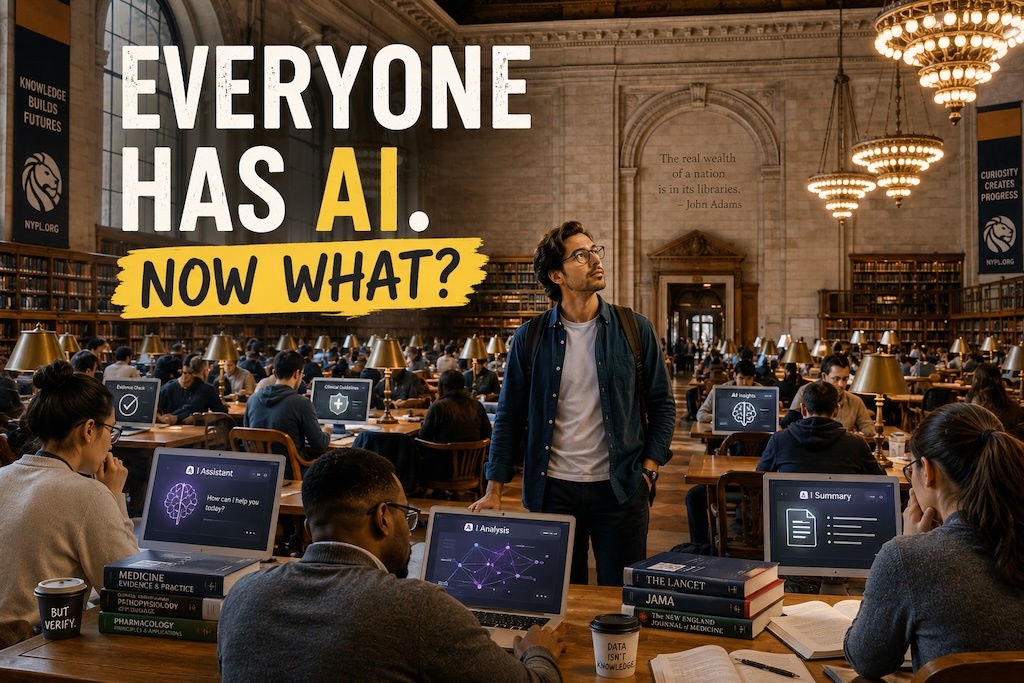
A recent Nature Medicine paper compared leading AI models with respected clinical tools like OpenEvidence and UpToDate Expert AI. The general-purpose models performed better across the board. Here’s what that means — and where the real value is moving.
A paper published in Nature Medicine recently reinforced a trend we’ve been watching for quite some time.
Researchers compared leading general-purpose language models — including GPT-5.2, Gemini 3.1 Pro Preview, and Claude Opus 4.6 — with two respected clinical AI tools used by physicians: OpenEvidence and UpToDate Expert AI.
The results were striking. Across medical knowledge tests, clinician-alignment benchmarks, and real-world physician questions, the general-purpose AI models consistently outperformed the specialized systems.
That may sound surprising at first. Services like UpToDate have spent decades building carefully curated, evidence-based knowledge repositories trusted by clinicians around the world. Their value has never been simply “having information.” It has always been about organizing, reviewing, and continuously updating medical evidence in a way physicians can rely on.
Ironically, those very knowledge bases likely helped train the generation of AI models that are now beginning to outperform them.
Technology has a sense of humor.
📄 Read the original Nature Medicine article here.
This Isn’t Really a Story About Medicine
It would be easy to read the paper as bad news for medical information companies. I don’t think that’s the real story.
The same dynamic is emerging across consulting, finance, law, education, software development, research, and other knowledge-intensive fields. When a general-purpose AI can match or exceed a specialized product on core questions, every company built around “expert answers” must confront a difficult question:
Why would customers keep coming back?
This doesn’t mean these companies disappear. It means the source of their value must evolve.
The New Competitive Advantage
Large language models are becoming infrastructure. Much like electricity, cloud computing, or the internet, they are steadily becoming something everyone can access.
Competing simply because you have access to GPT, Claude, or Gemini is unlikely to be a winning strategy. Everyone else can access the same tools.
The real differentiation lies in what is far harder to copy: unique datasets, well-designed workflows, deep integration into daily practice, strong partnerships, trusted brands, communities built over years, and genuine human relationships.
In short, AI becomes one powerful component inside a much larger, more resilient system.
Why This Matters for Healthcare
Healthcare has always been about more than answering isolated questions.
Clinicians need reliable systems that fit naturally into patient care, reduce administrative burden, connect with existing workflows, and support better decisions without creating new ones to manage. Because nothing says “progress” quite like giving a doctor another dashboard to babysit.
The same is true for patients.
People aren’t looking for another chatbot that can summarize a research paper. They are trying to understand what their diagnosis means, what treatment options exist, how to navigate insurance, where to find experienced specialists, what support communities are available, and what comes next.
These are not isolated questions. They are journeys. And journeys require context, continuity, and coordination — not just good answers.
What This Means for Organizations Like Ours
Patient organizations face the same strategic choice.
It would be easy to focus on building “another chatbot.” We don’t believe that’s where the greatest long-term value lies. Instead, we see AI as a foundational technology — an extraordinarily powerful one — but still just a foundation.
The organizations that create lasting impact will combine AI with elements that cannot simply be downloaded or replicated overnight: trusted communities, meaningful partnerships, unique real-world data, practical experience, and systems that help people move from confusion to confidence.
This philosophy has guided many of the initiatives we’ve been building.
Our long-running vitiligo.ai project continues to explore how AI can support patients in practical, meaningful ways. At the same time, we are working on a new generation of tools designed to help patients, clinicians, and researchers better navigate the full complexity of vitiligo.
We’ll have much more to share in the months ahead. We’re not particularly interested in competing with ChatGPT. We’re far more interested in building things that become more valuable because tools like ChatGPT exist.
The Nature Medicine paper doesn’t tell us exactly what the future will look like.
But it does highlight something important: the next generation of healthcare innovation won’t belong to whoever builds the smartest AI.
It will belong to those who build the most useful ecosystems around it.
And that is a future worth building.

by Yan Valle,
Prof. h.c., CEO VRF
Suggested Reading
AI Shopping for Therapies
A closer look at how patients may begin outsourcing therapy decisions to AI — and why that changes the rules for pharma, advocacy, and patient education.
AI’s Growing Role in Health Advice
As more people turn to AI for medical guidance, the real question is not whether they will use it. They already are. The question is how we help them use it wisely.
Building a Responsible AI-Powered Ecosystem in Vitiligo
Why AI in vitiligo should not be treated as a gadget, but as part of a broader ecosystem connecting patients, clinicians, researchers, and trusted knowledge.
🎙 Listen to Deep Dive in Vitiligo
The Vitiligo Corporate Trench Map
A field guide to the companies, strategies, and quiet power shifts shaping the future of vitiligo care.
AI for Vitiligo Patients — Beyond the Hype
A practical discussion of where AI can help patients today, where it still falls short, and why common sense remains medically underrated.
Can AI Predict Vitiligo Onset, Subtype and Activity?
A look at how AI may help identify patterns in vitiligo onset, subtype, and disease activity — and what still needs real-world validation.