


What the Science Actually Says About Vitiligo and Red Wine in 2026
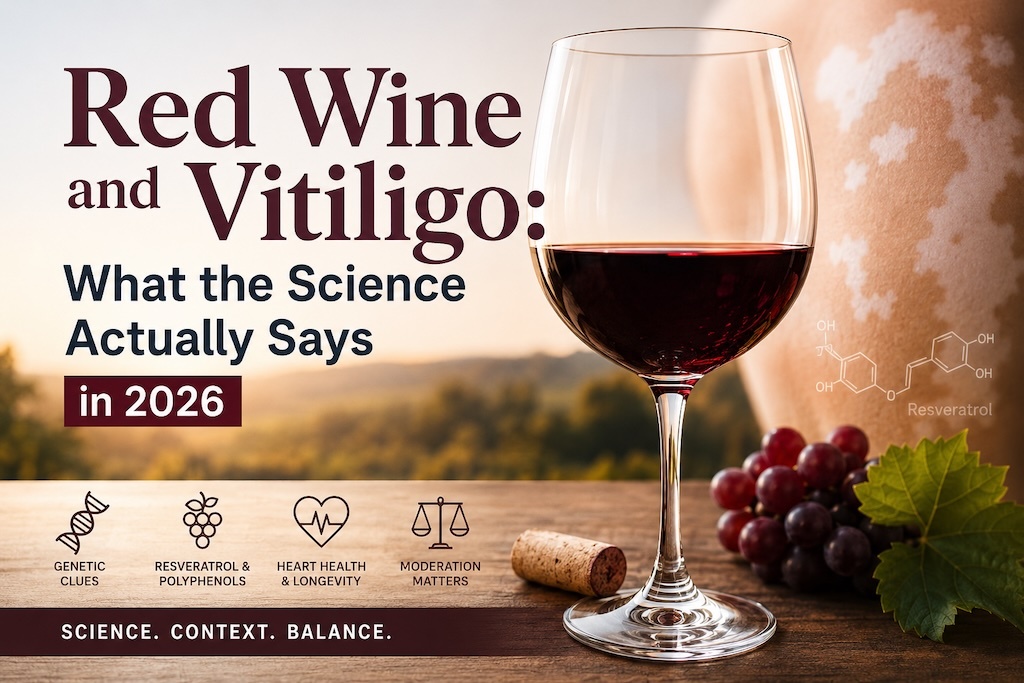
No, red wine is not a treatment for vitiligo. But the story around wine, inflammation, antioxidants, genetics, and living well is more interesting than the usual internet shouting match.
🎙️ Prefer listening to reading? This episode explores many of the same themes discussed in this article.
In Brief
Alcohol and autoimmune conditions have a complicated relationship. Heavy alcohol use is clearly harmful. But newer data suggest that not all alcoholic drinks show the same health pattern at low to moderate levels.
A 2024 Mendelian randomization study found that genetically predicted red wine intake was associated with a lower risk of vitiligo, including a reported 72% reduction in one higher-intake analysis. That sounds dramatic, but it should be read with caution: it does not prove that drinking red wine prevents or treats vitiligo.
A large 2026 UK Biobank analysis presented at the American College of Cardiology also found that wine consumption at low to moderate levels was associated with lower cardiovascular mortality, while beer, cider, and spirits showed less favorable patterns.
The practical takeaway is boring but useful: if you already enjoy an occasional glass of red wine with food and your health allows it, moderation is reasonable. If you do not drink, this is not a reason to start.
For years, the relationship between alcohol and autoimmune conditions has been a messy debate. On one side, alcohol is clearly pro-inflammatory — generally bad news for anyone dealing with vitiligo. On the other, red wine gets constant praise for its rich mix of antioxidants and polyphenols.
So the real question is: when you zoom in on vitiligo specifically, should you put the glass down completely, or is there actually a case for a moderate pour?
To answer that, we need to look at the newer data, the limits of the evidence, and one very Italian reminder from the late Prof. Torello Lotti: moderation still matters.
Contents
The Genetic Clue That Got Everyone Talking
Researchers using Mendelian randomization — essentially letting genetics function as a kind of natural randomized trial — found something intriguing. People with a genetic tendency toward moderate red wine consumption appeared to show a significantly lower risk of developing vitiligo in some analyses.
The headline figure was hard to ignore: a 72% reduction in vitiligo risk was observed for higher predicted weekly red wine intake in one analysis.
That got attention fast.
Unlike traditional nutrition surveys, this approach tries to reduce some of the usual problems with self-reported diet data and lifestyle confounders. The signal pointed researchers toward compounds found in red wine — particularly polyphenols and resveratrol — which are already known for antioxidant and anti-inflammatory effects.
That matters because oxidative stress is increasingly recognized as one of the central problems in vitiligo biology. Modern models of the disease no longer view vitiligo as simply “the immune system attacking pigment cells,” but as a broader failure of inflammatory control, oxidative balance, and tissue recovery.
Plant compounds like polyphenols are interesting precisely because they may influence several of these pathways at once.
Still, this is where people need to keep both feet on the ground.
A 72% risk reduction sounds impressive — and it is — but it does not mean that drinking red wine prevents vitiligo, stops progression, or restores pigment in a reliable therapeutic way. Genetic association studies can point toward biology worth exploring. They do not hand us a prescription pad and a corkscrew.
Science is a little slower — and usually less romantic — than internet headlines.
Source: Ni Y. et al. “The effect of antioxidant dietary supplements and diet-derived antioxidants on vitiligo: A Mendelian randomization study.” Frontiers in Nutrition, 2024. Read study.
Prof. Torello Lotti and the Italian Way
No discussion about red wine, resveratrol, and vitiligo feels complete without bringing up Prof. Torello Lotti.
In true Italian fashion, he has a signature move: he would often close his conference presentations with a final slide on the benefits of resveratrol — usually accompanied by a generous image of a good glass of red wine. Always, of course, with that small but crucial medical footnote: in moderation.
It was equal parts science and philosophy of living well. Lotti understands something modern medicine too often forgets: health isn’t only about pills, pathways, and lab values. It’s also about food, daily rhythm, stress, culture, joy, and how people actually choose to live.
This also points toward the famous Mediterranean diet — that strange and beautiful arrangement where olive oil, vegetables, fish, sunlight, conversation, and the occasional glass of wine somehow became a public health strategy. That, however, deserves its own separate post.
That doesn’t mean wine is a treatment for vitiligo. Let’s not get carried away and start prescribing Chianti like it’s a JAK inhibitor.
But it does make the whole conversation more human — and honestly, a little more honest.
And for anyone wondering, Prof. Lotti remains very much active, energetic, and enthusiastic about both dermatology and life, continuing to remind audiences around the world that good medicine is about more than simply treating disease.
The Bigger Picture on Alcohol: Not All Drinks Are Equal
A major study presented at the American College of Cardiology in 2026 added real weight to this conversation. Researchers analyzed alcohol consumption and mortality outcomes in 340,924 UK Biobank participants between 2006 and 2022.
The headline was no surprise: heavy drinking raised risks across the board. High alcohol intake was associated with a 24% higher risk of death from any cause, 36% higher cancer mortality, and 14% higher cardiovascular mortality.
Heavy is heavy. No miracle plot twist there.
But when researchers broke the results down by beverage type at low to moderate levels, the picture split. Spirits, beer, and cider were associated with higher mortality and cardiovascular risk. Wine went the other way, showing lower mortality risk at similar intake levels. Moderate wine drinkers had a 21% lower risk of dying from cardiovascular disease compared with never or occasional drinkers.
Why the difference?
Chemistry may play a role. Wine contains polyphenols, resveratrol, and other antioxidant compounds. But lifestyle probably carries just as much weight.
Wine tends to be consumed more slowly, often with meals, and often by people with higher diet quality and healthier baseline habits. Beer, cider, and spirits are more often associated with different drinking patterns, poorer diet quality, and higher-risk behavior.
That matters because observational data like this can’t prove causation. The researchers adjusted for demographics, socioeconomic factors, lifestyle, cardiometabolic factors, and family history, but confounders always linger. UK Biobank participants also tend to be healthier than the broader population, and drinking habits were self-reported at baseline.
Still, the scale and long follow-up give the findings real weight.
No one is claiming pinot noir is secret medicine. But the data quietly buries the idea that all alcohol hits the body the same way.
Source: American College of Cardiology. “The Health Impacts of Alcohol Depend on What You Drink and How Much.” ACC.26 press release, March 2026. Read ACC summary.
Important Caveats, Because Reality Still Exists
None of this suddenly makes alcohol “healthy.”
Heavy drinking remains clearly harmful. Even moderate intake can carry cancer risks for some people. Alcohol can disturb sleep, worsen anxiety, dehydrate skin, affect the gut, interact with medications, and increase inflammation in susceptible individuals.
For people with vitiligo, the picture is especially individual.
Some patients notice no relationship between moderate alcohol intake and their disease activity. Others report clear patterns tied to alcohol, stress, poor sleep, or the magical disaster cocktail of all three.
Your biology does not care about internet debates. It cares about the full context.
And this part is important: nobody is telling non-drinkers to start drinking for “health reasons.” If you do not drink, do not start because of resveratrol. Grapes, berries, peanuts, cocoa, and other plant foods also contain useful polyphenols, and they do not come with alcohol attached.
Plain-English moderation note:
A common guideline defines moderate alcohol intake as up to one 5-ounce glass of wine per day for women and up to two for men. But guidelines are not permission slips. If you are pregnant, have liver disease, take medications, have a history of alcohol dependence, cancer risk concerns, sleep problems, or active medical treatment, ask your doctor. Boring advice. Still good advice.
The Human Angle
Vitiligo isn’t just pigment loss. It’s daily stress, visibility, identity, uncertainty, and the exhausting mental math of managing something unpredictable.
So if an occasional glass of good red wine with dinner — enjoyed reasonably, with real food and a solid overall lifestyle — brings pleasure, relaxation, social connection, and maybe a modest antioxidant nudge, that’s part of living well too.
Not everything that matters fits neatly into a randomized trial.
That still doesn’t make wine a treatment. Keep both feet on the ground.
Real vitiligo care means proper diagnosis, treatment planning, phototherapy when appropriate, topical and systemic therapies where suitable, camouflage options if helpful, psychological support when needed, and a serious look at oxidative stress, sleep, diet, and inflammation.
But maybe Prof. Lotti had the broader view right all along. Health rarely comes from one miracle molecule. It is the slow accumulation of small decisions, habits, environments, relationships, and rhythms over time.
And that’s why his famous final slide stuck with so many. Not because it promised a cure. But because it reminded us — doctors and patients alike — that living well still counts.
Stay curious. Stay evidence-based. And if you do pour a glass, do it like the old professor suggested: with awareness, with pleasure where it fits, and always in moderation.
– by Yan Valle, Prof. h.c., CEO VRF
Recommended Reading
Diet, Microbiome, and Vitiligo: Unveiling the Mystery
A deeper look at how food, gut health, inflammation, and immune balance may connect with vitiligo biology.
Relationship Between Smoking and Vitiligo
A practical look at smoking, oxidative stress, inflammation, and why skin biology is rarely amused by cigarettes.
Gut Feelings: How Your Microbiome Talks to Your Brain (and Skin)
The gut-brain-skin conversation, explained without turning your microbiome into a horoscope.
Listen To Deep Dive in Vitiligo
Red Wine, Black Coffee, and Why Your Antioxidant Pills Are Ghosting You (Ep. 69)
We explore recent genetic studies showing why antioxidant-rich dietary rituals — like drinking coffee, tea, or a moderate glass of wine — show protective signals against vitiligo, while isolated supplement capsules often fall flat.
Why You’re Sleepy After Lunch and What It Means For Vitiligo (Ep. 46)
A practical episode on blood sugar, energy crashes, inflammation, and why your afternoon slump may be telling you something.
Vitiligo and Vitamins. Hope or Hype? (Ep. 30)
A grounded discussion of supplements, expectations, and where hope ends and expensive urine begins.
Final Word
Red wine is not a vitiligo therapy. But the science around antioxidants, alcohol type, oxidative stress, and lifestyle is worth understanding. As usual, the answer is not “miracle” or “panic.” It is context, moderation, and a little less nonsense.