

New

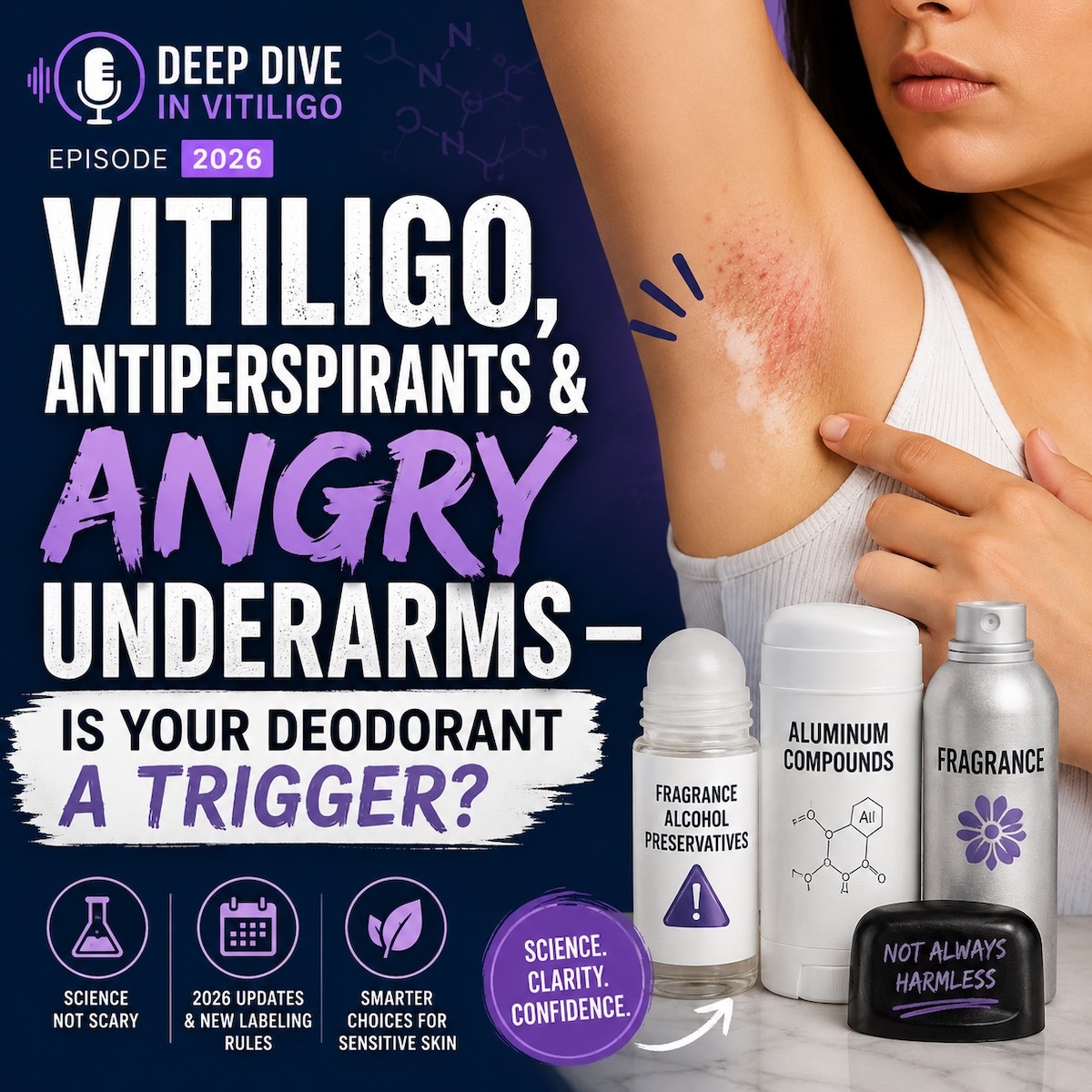
Vitiligo, Antiperspirants & Angry Underarms — Is Your Deodorant a Trigger?
A few years back, a straightforward email dropped into the inbox and got me digging into whether that daily swipe under the arms could actually mess with vitiligo.
The question hasn’t gone away. If anything, with more people paying attention to what they put on sensitive skin — especially in areas where vitiligo likes to show up — it’s worth revisiting.
We still reach for deodorants to handle sweat and smell. Most contain antibacterial ingredients, fragrances, preservatives, and, in the case of antiperspirants, aluminum compounds. These products work by reducing odor-causing bacteria or limiting sweat. Simple enough.
But some ingredients have raised eyebrows for years — mostly around irritation, allergies, and broader health concerns. The important point for vitiligo is this: there is still no solid evidence that ordinary deodorants or antiperspirants directly cause vitiligo.
That said, underarm skin is not exactly a peaceful diplomatic zone. It is warm, moist, folded, shaved, rubbed by clothing, covered with product, and then expected to behave beautifully. Sometimes it does not.
This is an update to the original post from August 2023.
Prefer listening? Check out the accompanying podcast episode here.
In Brief
There is no good evidence that ordinary deodorants or antiperspirants directly cause vitiligo.
The real concern is irritation: fragrance allergy, preservatives, alcohol, baking soda, essential oils, shaving trauma, and repeated inflammation.
In vitiligo-prone skin, irritation may matter because skin injury and inflammation can sometimes contribute to new or worsening patches.
If a product burns, itches, causes a rash, or leaves your underarm inflamed, stop using it. Your armpits should not feel like a policy debate.
On This Page
The contact angle
Vitiligo is about melanocyte loss. Melanocytes are the pigment-producing cells that give skin its color.
Contact vitiligo, also called chemical leukoderma, happens when repeated exposure to certain chemicals — especially phenolic and catecholic derivatives — triggers depigmentation that can persist. It is different from straightforward allergic contact dermatitis, although the two can overlap. One may also aggravate the other.
This distinction matters.
It is not quite accurate to say, “Deodorant causes vitiligo.” That is too broad and too dramatic. The better question is whether certain ingredients, in certain people, on already vulnerable skin, can contribute to irritation or chemical depigmentation.
That answer is more cautious: possibly, yes.
Deodorants and perfumes have appeared in studies of chemical leukoderma as possible culprits. In some Indian research, deodorant and perfume exposure was reported in over 20% of chemical leukoderma cases, ranking behind hair dyes.
This does not mean your standard deodorant stick is guaranteed to cause new patches. It means that if you already have vitiligo, especially active or spreading vitiligo, irritated underarm skin deserves attention.
Nickel, fragrances, and certain preservatives remain common triggers for contact allergies. Patch testing is still the best way to know whether you are reacting to something specific.
What’s new in 2026 since the original post from 2023?
There has not been a flood of fresh research zeroing in on deodorants and vitiligo specifically. The core science has not flipped.
Chemical leukoderma from consumer products is still recognized. Armpits remain a vulnerable area because of thin skin, occlusion, shaving, sweat, friction, and frequent product use.
On the regulatory side, there have been no major new FDA or EMA warnings tying typical deodorant ingredients — including aluminum compounds or parabens — directly to vitiligo progression.
Antiperspirants remain regulated as over-the-counter drug products in the United States because they reduce sweating. Aluminum-based antiperspirant ingredients are still considered acceptable for most people when used as directed, with the usual caution for people with kidney disease.
There was, however, a notable product recall in 2025 involving more than 67,000 cases of Power Stick roll-on antiperspirant deodorants in various scents. The issue was linked to manufacturing practice violations, not a vitiligo-specific concern or confirmed toxic ingredient problem. Still, it is a useful reminder: quality control matters, even for everyday products we barely think about.
The European Union is also expanding fragrance allergen labeling. The older 26-fragrance-allergen system is being broadened significantly, with new labeling rules gradually rolling out through 2026–2028. In plain English: ingredient labels may slowly become more useful for people with fragrance sensitivities.
This is good news. “Fragrance” or “parfum” can hide a lot. Better labeling does not solve every problem, but it gives patients and dermatologists a better map. And in skin care, a map beats guessing in the dark with a scented stick.
Natural does not always mean gentle
Many people with sensitive skin switch to “natural” deodorants hoping for fewer problems.
Sometimes that works beautifully. Sometimes it turns the armpit into a small angry republic.
Natural deodorants often avoid aluminum, but they may contain baking soda, essential oils, citrus extracts, tea tree oil, lavender, limonene, linalool, and other fragrance-related ingredients. These can be irritating or allergenic in some people.
Baking soda is a frequent offender because it is alkaline and can disrupt the skin barrier. Some people tolerate it well. Others get redness, burning, itching, peeling, or darkening.
For vitiligo-prone skin, repeated irritation is not a charming wellness experiment. It is a signal to change course.
Smarter choices in 2026
The market has shifted toward gentler options, which is good news for anyone with reactive or depigmented skin.
Look for products that are:
- Fragrance-free rather than merely “unscented”
- Alcohol-free
- Baking soda-free if you react to natural deodorants
- Hypoallergenic or dermatologist-tested
- Simple in ingredient design
- Made for sensitive skin
Commonly discussed sensitive-skin options include Vanicream, Almay Sensitive Skin, Native Sensitive or Unscented, Dove 0% Aluminum Sensitive, Nécessaire, Hume Supernatural, Lume Unscented, and some pharmacy-style brands such as La Roche-Posay or Vichy where available.
This is not an endorsement of any one product. Your skin gets the final vote. Dermatology is democracy at the cellular level.
Some newer formulas use mandelic acid, lactic acid, prebiotics, magnesium, diatomaceous earth, or simple moisture-absorbing ingredients to control odor without traditional antiperspirant action. These can be helpful for some people, but they are not magic. Acids can sting. Botanicals can irritate. “Clean” branding does not guarantee clean behavior on your skin.
A note on whole-body deodorants
Since 2024, the deodorant aisle has grown a new personality: whole-body deodorants.
Brands such as Lume, Dove, Secret, Old Spice, Native, Sure, Lynx/Axe, and others have promoted sticks, creams, sprays, and wipes for use beyond the underarms — feet, groin folds, under the breasts, inner thighs, and other areas where marketing departments now boldly go.
Are these products automatically dangerous? No.
Are they necessary for most people? Also no.
For people with vitiligo, eczema, sensitive skin, or active inflammation, location matters. Skin folds are more delicate. Groin-adjacent areas are more reactive. Sweat, friction, fragrance, and occlusion can make irritation more likely.
So the practical rule is simple: do not use a fragranced deodorant everywhere just because the label says “whole body.” The body already has enough jobs. It does not need a corporate fragrance strategy.
How to test a new deodorant
Do not test a new product on freshly shaved skin.
Apply a small amount to a limited area for several days. Watch for itching, burning, redness, peeling, bumps, swelling, or new irritation.
If your skin reacts, stop.
If the reaction keeps returning, ask a dermatologist about patch testing. Patch testing can help identify fragrance allergy, preservative allergy, propylene glycol sensitivity, nickel sensitivity, or other contact allergens.
Guessing is fun for birthday gifts. Less so for dermatitis.
When to stop immediately
Stop using a deodorant or antiperspirant if you notice:
- Burning
- Persistent itching
- Rash
- Scaling or peeling
- Painful bumps
- Swelling
- Skin darkening after irritation
- New pale spots appearing exactly where inflammation occurred
- Recurrent underarm eczema
If new depigmented patches appear after repeated irritation, take photos, stop the suspected product, and speak with a dermatologist. This is especially important if the area is actively spreading.
A practical routine for vitiligo-prone underarms
Use a gentle cleanser. Avoid aggressive scrubbing. Shave carefully, or consider trimming instead.
Do not apply deodorant immediately after shaving if your skin stings. Avoid fragranced products during flares. Wear loose, breathable clothing when possible.
Also, do not layer deodorant, perfume, body spray, and scented lotion in the same area. Your underarm is not a chemistry lab. It just plays one in modern life.
If you are treating underarm vitiligo with topical medication, ask your dermatologist how deodorant should fit around the treatment schedule.
Bottom line
There is no smoking gun saying all deodorants cause vitiligo. Antiperspirants are not the villain the internet sometimes wants them to be.
But irritated skin can matter in vitiligo. And deodorants, especially fragranced formulas, harsh “natural” products, or products used right after shaving, can irritate underarm skin in some people.
So the advice is not panic. The advice is: pay attention.
If your deodorant feels invisible, works well, and causes no irritation, fine. Keep living your life. The world has larger problems than your armpit brand.
But if it burns, itches, causes eczema, or seems to trigger new patches in the same area, change it. Choose a simpler product. Go fragrance-free. Ask about patch testing if the problem repeats.
In vitiligo care, small irritations can sometimes become big annoyances.
And frankly, vitiligo already provides enough plot twists.

— Yan Valle
Prof. h.c., CEO VRF
Suggested Reading
If this topic caught your attention, these related VRF guides go deeper into everyday skin triggers — cosmetics, gloves, shaving, waxing, and the small “harmless” routines that sometimes are not so harmless after all.
The Hidden Danger of Cosmetics: Vitiligo and Other Skin Problems
A practical look at how cosmetics, fragrances, dyes, and other everyday products may irritate the skin or contribute to chemical leukoderma. Useful if you want to understand why “safe for most people” does not always mean “safe for my skin.”
Which Work Gloves Are Safer for Vitiligo on the Hands
Hands take a beating from friction, chemicals, sweat, detergents, rubber, latex, and protective gear. This guide explains how to choose safer gloves when vitiligo affects the hands — because protection should not quietly become the problem.
Hair Removal and Vitiligo: What Every Woman Should Know Before She Waxes, Shaves, or Lasers
Shaving, waxing, threading, and laser hair removal can all irritate the skin in different ways. This article walks through what to watch for, how to reduce trauma, and when beauty maintenance starts acting like a tiny dermatological ambush.
Listen to Deep Dive in Vitiligo
Prefer listening while walking, driving, cooking, or pretending to clean your inbox? These podcast episodes explore safety, the skin-body connection, and the bigger biological picture behind vitiligo.
How Antidepressants Shape Your Body and What It Means For Vitiligo (Ep. 53)
A thoughtful episode on how medications can influence the body far beyond the original target. Not alarmist, not anti-treatment — just a clearer look at how the nervous system, skin, metabolism, and immune activity may be connected.
Biologics, Creams, and the Safety Factor in Vitiligo (Ep. 44)
A plain-English discussion of treatment safety in vitiligo, from topical therapies to newer immune-targeting drugs. Helpful for anyone trying to separate real medical caution from internet-grade panic in a lab coat.
Vitiligo, Antiperspirants & Angry Underarms — Is Your Deodorant a Trigger? (Ep. 67)
In this episode of Deep Dive in Vitiligo, we explore the science behind deodorants, antiperspirants, fragrance allergies, chemical leukoderma, and why underarm skin may deserve more attention than most of us give it.
FAQOther Questions
- PTSD in Vitiligo?
Living with vitiligo often involves more than managing visible skin changes. Many individuals face discrimination, social stigma, and feelings of isolation, leading to emotional...
- Which skin conditions can be mistaken for vitiligo?
Vitiligo is a common skin condition with characteristic milky white patches of irregular shape. However, several other skin conditions exhibit similar symptoms that can lead to ...
- Any link between vitiligo and military service?
While there isn't specific research directly linking military service to the onset of vitiligo, it's critical to comprehend that vitiligo is a multifaceted disorder influenced b...
Though it is not always easy to treat vitiligo, there is much to be gained by clearly understanding the diagnosis, the future implications, treatment options and their outcomes.
Many people deal with vitiligo while remaining in the public eye, maintaining a positive outlook, and having a successful career.
Copyright (C) Bodolóczki JúliaBy taking a little time to fill in the anonymous questionnaire, you can help researchers better understand and fight vitiligo.