

Alright — here’s the story, in order.
Intro
Last year, I wrote about vitiligo's "White Armour" — the surprising data suggesting lower overall mortality and lower risk across several disease groups, including cancer-related outcomes.
Now we have a fresh, bigger synthesis focused specifically on cancer. The punchline is both reassuring and annoyingly specific: overall cancer risk looks lower in people with vitiligo, but thyroid cancer risk looks higher.
What the new meta-analysis found
A 2025 systematic review and meta-analysis pooled 13 observational studies, screening nearly 10,000 publications across PubMed, Embase, Web of Science, and Cochrane Library (searches through February 2025).
Compared with people without vitiligo, the pooled estimates showed:
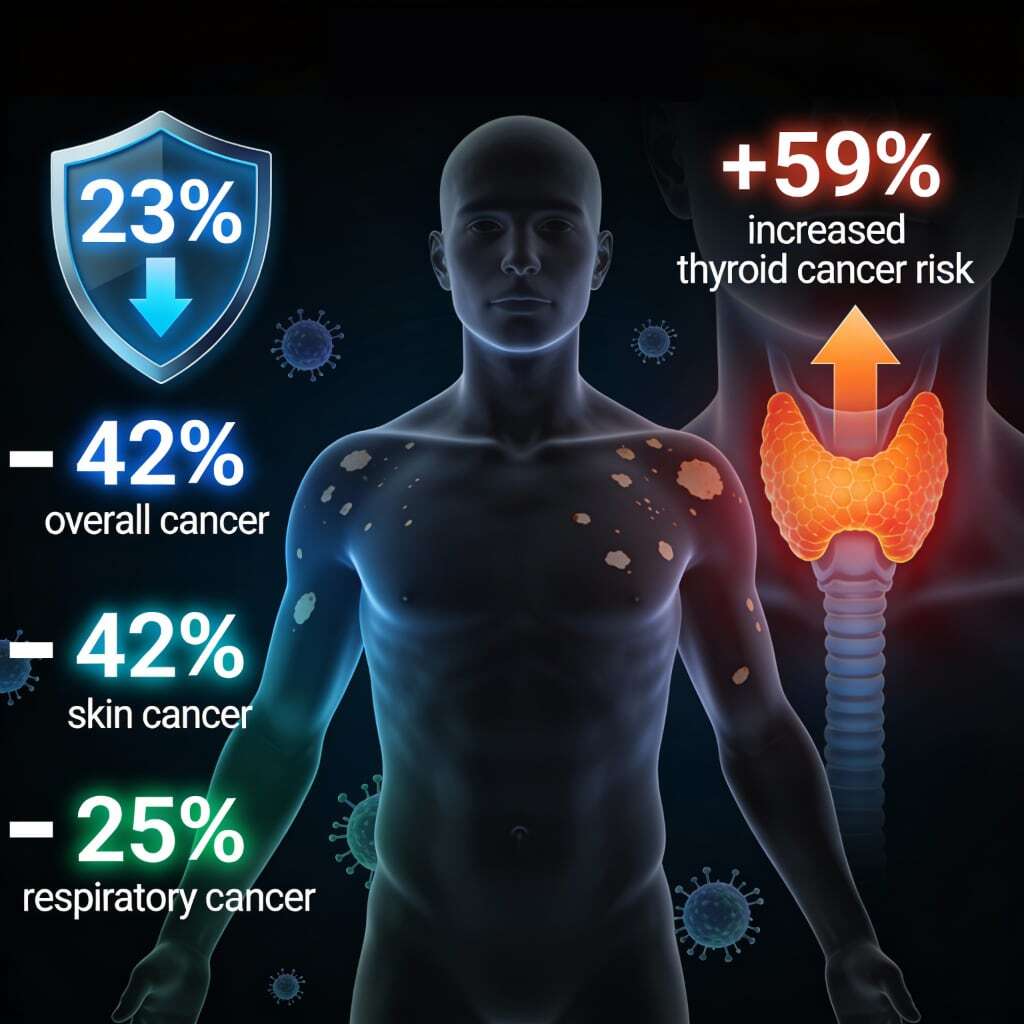
- Lower overall cancer risk (RR 0.77 — a 23% reduction)
- Lower respiratory system cancer risk (RR 0.75)
- Lower digestive system cancer risk (RR 0.74)
- Lower skin cancer risk (RR 0.58 — a 42% reduction)
And one clear increase:
- Higher thyroid cancer risk (RR 1.59 — a 59% increase)
If relative risks make your eyes glaze over, here's the plain-English translation: on average, vitiligo was linked to fewer cancers overall, but the thyroid didn't get the memo.
These aren't marginal differences. The protective effects are substantial and statistically significant across multiple cancer types. The skin cancer reduction is particularly striking, extending the "white armour" metaphor beyond melanoma to encompass broader dermatological malignancies.
The thyroid exception (and why it's plausible)
Vitiligo is strongly entangled with thyroid autoimmunity. That connection is not controversial; it's one of the most consistent comorbidities in the field.
So a thyroid signal showing up in cancer statistics could reflect several overlapping realities:
- A real biology link in a subgroup (autoimmunity clustering is a thing)
- More medical contact and more thyroid testing (surveillance bias)
- More imaging finding tiny thyroid nodules that might never have caused trouble (overdiagnosis is a known issue in thyroid cancer screening conversations)
That last point matters because "more diagnoses" doesn't always mean "more dangerous disease." Thyroid cancer often has an excellent prognosis, and population screening has a long history of creating harm via unnecessary workups and overtreatment.
The increased thyroid cancer risk likely reflects shared autoimmune pathways rather than a failure of vitiligo's broader cancer surveillance. People with vitiligo experience elevated rates of autoimmune thyroid disease (Hashimoto's thyroiditis, Graves' disease), and chronic thyroid inflammation may create a microenvironment conducive to thyroid malignancy.
What this means in real life
Let's keep this practical.
First, don't treat this as a reason to panic or to start hunting for cancer with a microscope.
Second, don't ignore your thyroid either — just be smart about it.
What "smart" looks like for most people with vitiligo:
- Stick to standard age-appropriate cancer screening in your country (colon, breast, cervix, lung in high-risk groups, etc.)
- Use common sense sun protection (not because vitiligo "causes skin cancer," but because sunburn is still a bad idea and can trigger flares)
- Talk to your clinician about thyroid evaluation if you have symptoms, a strong family history, or known thyroid autoimmunity
If you want a simple symptom reality-check for thyroid/neck issues: take hoarseness that doesn't go away, a new neck lump, trouble swallowing, or persistent neck discomfort seriously. Those are reasons for an exam.
One more nuance: many organizations discourage routine "lab fishing expeditions" in asymptomatic vitiligo patients. So if you feel fine and have no red flags, blanket testing is not automatically the gold standard either.
What this does not mean
This meta-analysis is strong as a synthesis, but it's still built on observational studies.
So it does not prove:
- That vitiligo directly protects you from cancer
- That vitiligo directly causes thyroid cancer
- That everyone with vitiligo should get thyroid ultrasounds "just in case"
It also can't fully untangle confounders (smoking, healthcare utilization, medications, disease extent, regional screening habits). The authors themselves note issues like surveillance bias and residual confounding when interpreting the risk reductions.
How this updates "White Armour"
The "White Armour" idea was never "vitiligo is a magic shield." It was: the immune system in vitiligo behaves differently, and that difference may show up in population-level outcomes — including lower risks in some disease categories.
This new paper doesn't kill the story. It sharpens it.
Think of it like this:
- The immune "security team" may be better at spotting certain abnormal cells (hence lower overall/respiratory/digestive/skin cancer signals). Heightened immune surveillance, enhanced cellular housekeeping (autophagy), and an immune system primed to detect abnormalities before they become cancerous likely underlie these protective effects.
- But the thyroid sits in a neighborhood where autoimmunity is already loud, common, and medically over-observed — and that can change what gets detected and labeled.
The dual risk profile doesn't overturn the "white armour" concept — it refines it with precision. Vitiligo's protective effects against cancer are real, substantial, and extend across multiple organ systems. But the armour has a gap, and that gap requires clinical attention without clinical paranoia.
Bottom line
If you have vitiligo, the best takeaway is boring (which is usually a good sign):
Follow standard screening guidelines, protect your skin, and don't ignore thyroid symptoms, but also don't go shopping for a diagnosis you didn't need.
Understanding vitiligo's dual cancer profile transforms abstract epidemiology into actionable clinical guidance. Patients can be reassured about overall cancer risk while remaining appropriately vigilant about thyroid health. And the metaphor of "white armour" endures — not as poetic license, but as epidemiological reality, now mapped with precision across the cancer landscape.

Yan Valle
Prof. h.c., CEO VRF | Author "A No-Nonsense Guide To Vitiligo"
Further reading
- Vitiligo's White Armour: A Shield Against Mortality & Diseases?
- Vitiligo's Unexpected Health Benefits
- Placebo Effect in Vitiligo
Podcast Deep Dive in Vitiligo
- What If Vitiligo Isn’t One Disease, But Five? (Ep. 47)
- Vitiligo’s New Suspect: Your ZIP Code (Ep. 42)
- Vitiligo’s White Armour: A Shield Against Mortality & Diseases? (Ep. 19)