

New

Vitiligo Got a Reality Check: It's More Than Just an Autoimmune Problem
A major 2026 scientific review suggests vitiligo may not simply be an autoimmune disease, but a failure of immune resolution and skin regeneration. Here’s what that means in plain English — and why it could reshape future treatment strategies.
Vitiligo Got a Reality Check: New Paper Says It’s More Than Just an Autoimmune Problem
In Brief
A new scientific review published in Clinical Reviews in Allergy & Immunology argues that vitiligo is not simply an autoimmune disease where the immune system attacks pigment cells.
Researchers increasingly believe vitiligo is also a failure of the skin’s ability to properly resolve inflammation and regenerate lost pigment.
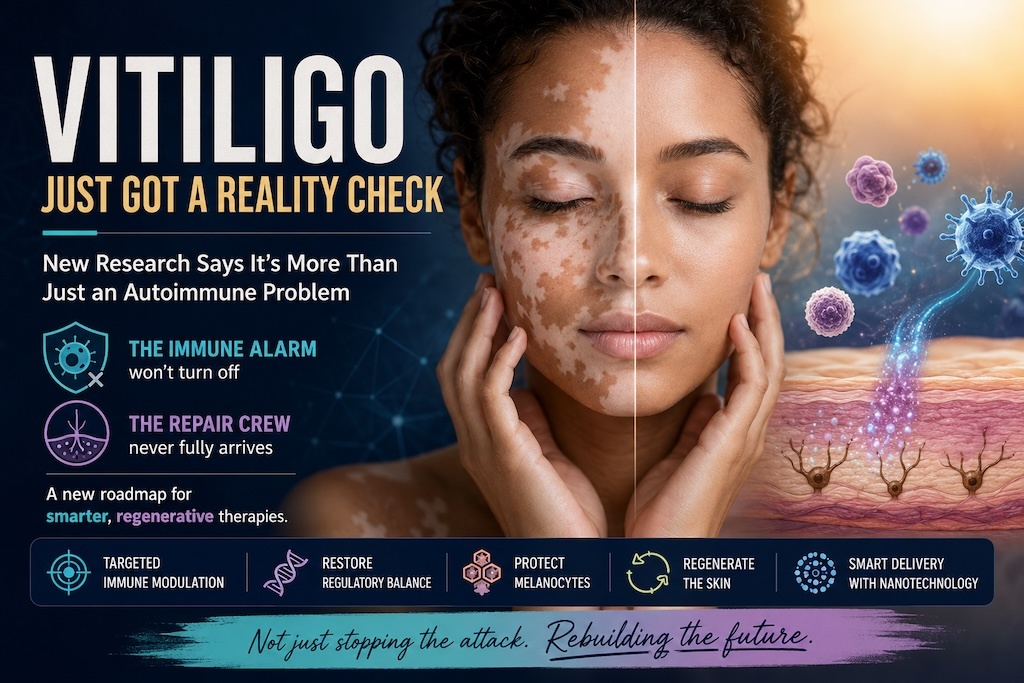
This shift matters because it changes how future treatments are being designed. Instead of only suppressing immunity, scientists are now exploring ways to:
- control harmful immune memory
- restore immune regulation
- protect melanocyte reservoirs
- support long-term skin regeneration
- improve drug delivery using nanotechnology
In short: the field is moving from “stop the attack” toward “repair the ecosystem.”
What's Inside
The Old Autoimmune Story
If you’ve been living with vitiligo, you already know the basic story doctors have told for years: the immune system attacks melanocytes, the cells that make pigment.
So we try to calm the immune attack with steroids, light therapy, immunosuppressants, and newer targeted drugs. Sometimes it works surprisingly well. Sometimes the pigment comes back halfway and leaves again like a tenant that never fully unpacked.
A major review published on May 9, 2026, in Clinical Reviews in Allergy & Immunology is quietly blowing up the old playbook. The paper, titled “Vitiligo as a Failure of Immune Resolution and Tissue Regeneration: From Stress Signals to Targeted Immune Modulation,” lays it out straight: vitiligo isn’t just autoimmunity gone wild.
It’s a two-headed beast — your skin’s immune system can’t turn off the alarm, and the repair crew that should rebuild pigment is nowhere to be found.
A New Framework: Failed Recovery
The authors describe vitiligo as “failure of immune resolution plus impaired tissue regeneration.”
Translation: memory immune cells keep the fight going long after the initial trigger, the regulatory brakes are weak or missing, and the skin never really gets back to normal homeostasis.
No wonder repigmentation has often felt unpredictable and frustrating. You can stop the attack, but the melanocytes don’t necessarily come back to work.
This actually matters because it helps explain why so many patients experience partial wins followed by frustrating relapses.
The old “just suppress everything” approach treated the symptom, not necessarily the deeper breakdown underneath it.
The New Treatment Toolkit
Here’s the encouraging part. Over the past decade the field has quietly built a much smarter toolkit.
The new approaches include:
- Targeted cytokine and kinase inhibitors
- Immune checkpoint modulation — the “on/off switches” of immune cells
- Restoration of regulatory immune pathways
- Phototherapy that doubles as immunoregeneration
- Pro-melanogenic agents that encourage pigment recovery
- RNA- and DNA-based therapies
- Extracellular vesicles
- Cell-based regenerative strategies
The shift is from blanket suppression toward mechanism-informed treatment: calm the rogue immune memory, protect surviving melanocytes, and help the skin repopulate properly.
Why Combination Therapy Makes Sense
The review also strongly supports combined and sequential treatment strategies.
In plain English: first calm the inflammation, then stimulate repigmentation, then maintain stability long-term.
Honestly, once you say it out loud, it sounds almost obvious. But biology enjoys humbling humans on a regular basis.
Many of these therapies remain early-stage or experimental. Long-term safety and efficacy data are still limited, and real-world clinical translation remains slow.
The skin’s outer layer — the stubborn stratum corneum — acts like a biological brick wall for many promising molecules. Manufacturing challenges, regulatory barriers, and the need for larger long-term studies still stand in the way.
Why Nanotechnology Matters
One technology keeps appearing throughout the paper as the quiet enabler: nanotechnology.
Not as some flashy cure-all, but as a GPS system for medicine — helping treatments reach the precise layers of skin where they are actually needed.
Nanotechnology-based delivery systems may help:
- improve drug stability
- increase penetration into the skin
- allow controlled slow release
- target specific immune and pigment-cell compartments
- reduce unwanted systemic side effects
It works across small molecules, biologics, RNA-based therapies, and regenerative agents. Think of it as the bridge between impressive laboratory science and something a dermatologist might actually prescribe one day.
The Bigger Shift Happening in Vitiligo
Bottom line? The paper doesn’t promise miracles next year.
It does something better: it reframes vitiligo as a solvable engineering problem.
Modulate harmful immune memory. Restore regulatory networks. Rebuild the regenerative niches where melanocytes can thrive again. Less carpet bombing. More ecosystem repair.
That convergence of precision medicine, immunoengineering, regenerative biology, and smart drug delivery may become the realistic path forward.
At VRF, we’ve been saying for years that patients deserve better than temporary fixes and 20th-century bandaids. This review backs that up with fresh science. It’s not hype. It’s the next chapter.
Stay curious, keep pushing, and we’ll keep tracking every real step forward. Because vitiligo patients are not just waiting for color to come back. They are part of the reason the science keeps moving forward.

By Yan Valle, Prof. h.c.
CEO, Vitiligo Research Foundation
Behind the Scenes of This Post
Real talk on how this post came together
The original review was an absolute monster — more than 15,000 words of dense immunology, molecular biology, and emerging therapies, packed with references, figures, and tables.
For perspective, most scientific papers land around 4,000–5,000 words. This thing was easily triple that size.
Reading it cover to cover would take most people well over an hour. Fully digesting it would realistically require advanced training in immunology or dermatology… which, I’ll admit, is not exactly on my résumé.
Grok AI helped distill the key scientific concepts into plain English summaries, while ChatGPT helped shape and structure the final article you’re reading here on the VRF website.
Science moves fast. Making it understandable is the part that actually helps people.
Suggested reading:
- The Nervous System Just Entered the Vitiligo Story Again
- Vitiligo and Cancer Risk: The "White Armour" Still Holds, But the Thyroid Is the Exception
- Who Gets to Do Vitiligo Science?
- Sixty Years of Vitiligo Research: Where We’ve Been and Where We’re Going
Listen to Deep Dive in Vitiligo podcast
- The State of Vitiligo 2025: A Fast-Moving Field With Slow-Moving Funding (Ep. 57)
- Nanotechnology for Vitiligo — Tiny Tools, Big Hopes (Ep. 49)
- What If Vitiligo Isn’t One Disease, But Five? (Ep. 47)
FAQOther Questions
- Can Ginkgo Biloba help with vitiligo?
Ginkgo Biloba offers a promising, simple, and relatively affordable option for managing vitiligo. Known for its anti-inflammatory, immunomodulatory, and antioxidant properties, ...
- Vitiligo and Pregnancy
Pregnancy with vitiligo? The good news: vitiligo itself doesn’t make pregnancy unsafe. Most women stay stable (some even improve), though flares can pop up after birth — usually...
- Isn't it just a cosmetic disorder?
Contrary to popular belief, vitiligo is not merely a cosmetic issue but a complex autoimmune disorder that affects the body’s largest organ—along with other vital systems—and is...
Though it is not always easy to treat vitiligo, there is much to be gained by clearly understanding the diagnosis, the future implications, treatment options and their outcomes.
Many people deal with vitiligo while remaining in the public eye, maintaining a positive outlook, and having a successful career.
Copyright (C) Bodolóczki JúliaBy taking a little time to fill in the anonymous questionnaire, you can help researchers better understand and fight vitiligo.