New

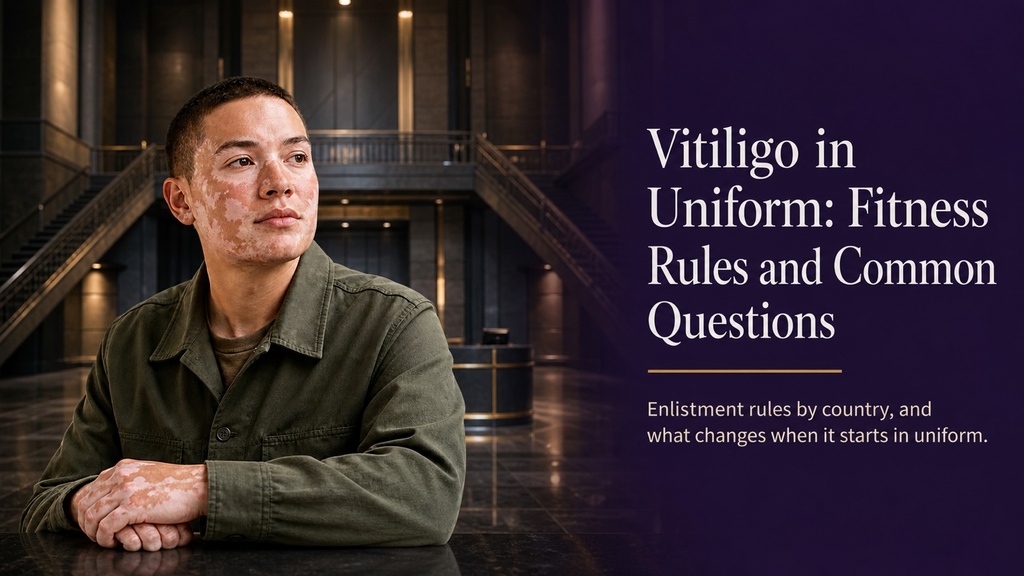
Vitiligo in the Military – Fitness Rules and Common Questions
Military service · Patient guide · Rules checked August 2026
A white patch can open three very different files: Can I join? Can I stay? Did service cause or aggravate it?
The diagnosis may be the same. The question—and the evidence needed—is not.
Vitiligo in uniform is often squeezed into one vague question: Is it military-related? That shortcut causes trouble before the paperwork even begins.
A person may be medically fit to serve, develop vitiligo during service, and still have no proof that service caused it. Another may have limited patches that do not affect duty at all, but a well-documented injury, exposure, or aggravation that matters in a later disability claim.
In Brief
Vitiligo does not automatically answer whether someone may enter or remain in military service. National rules differ, accession and retention use different standards, and specialized occupations may be stricter.
Military stress, skin trauma, friction, certain chemicals, and severe sunburn can be medically relevant to onset or worsening, but timing and plausibility are not the same as proof of causation. Records, chronology, lesion location, and a defensible medical opinion do the heavy lifting.
What’s inside
One diagnosis. Three separate questions.
1. Am I fit to enter service?
Accession standards ask whether an applicant with pre-existing vitiligo meets the medical rules for appointment, enlistment, or induction. The answer can depend on the country, branch, extent and location of patches, associated autoimmune disease, treatment needs, and occupation. Aviation, diving, submarines, and special operations may add another layer of scrutiny.
2. Am I fit to remain in service?
Retention standards ask whether a trained service member can still perform required duties safely. They are often more functional and case-specific than entry rules. A condition that complicates accession may have little effect on retention when it is stable, manageable, and does not interfere with equipment, treatment access, deployment, or performance.
3. Did service cause or aggravate the condition?
Service connection is a medical and legal question about causation or aggravation. It is not answered merely because vitiligo appeared while someone was wearing a uniform.
The calendar proves timing.
It does not, by itself, prove cause.
How do national fitness rules compare?
There is no global military rule for vitiligo. Even within one country, entry, retention, branch, trade, and waiver decisions may follow different tracks. The comparison below uses the best public material available as of August 2026; applicants should confirm the current rule with the recruiting or military medical authority handling their case.
| Setting | What the public rules show |
|---|---|
| United States | DoD publishes separate instructions for accession and retention. The February 2026 accession instruction does not name vitiligo among its disqualifying skin conditions; applicants who miss another standard may be considered for a waiver unless that condition is on the separate no-waiver list. Retention standards are applied case by case by the services. 2026 accession instruction ↗ · Waiver and retention overview ↗ |
| United Kingdom | The latest detailed edition available publicly through an official FOI release, dated October 2022, says a candidate with vitiligo and no other autoimmune disorder may be found fit. In-service guidance distinguishes limited skin disease from disease that impairs function or resists treatment. The MOD now lists current JSP 950 medical policy as internal, so this public wording should be confirmed for a live application. Public JSP 950 edition ↗ |
| India | Published Indian Air Force officer-entry standards are stricter: minor leukoderma on covered areas may be accepted, but extensive involvement—and even minor involvement of exposed areas—is described as unfit. Standards can vary by service and entry route. Indian Air Force notice, dermatology section ↗ |
| Russia | The military-medical schedule uses unusually specific thresholds. Its definition of widespread vitiligo includes three or more patches on different anatomical regions, each at least 10 cm across; two or more facial patches at least 3 cm also qualify. Fitness categories then depend on the examination column and extent. The consolidated regulation was listed as amended through March 24, 2026. Government Regulation No. 565 ↗ |
| Brazil | The picture is inconsistent and evolving. A review of 97 Armed Forces, police, and fire-service recruitment notices from 2009–2022 found that 55 excluded people with vitiligo from at least some roles. Yet a January 2026 federal Army recruitment notice explicitly excepted vitiligo in its autoimmune-skin wording. That is evidence of variation, not one timeless national rule. Recruitment-notice review ↗ · 2026 federal notice ↗ |
Reading note: “May be found fit” is not a promise of acceptance, and a published entry standard is not necessarily the rule used for retention or a specialized military occupation.
Can military service trigger or localize vitiligo?
Military service itself has not been established as a general cause of vitiligo. Vitiligo is a complex autoimmune disease, and in most people no single trigger can be identified.
But military life can contain exposures that overlap with recognized or suspected vitiligo triggers. The useful question is not, “Was this person in the military?” It is, “What happened, when, and where did the first patches appear?”
Does psychological stress or PTSD cause vitiligo?
Stress is frequently reported before onset or worsening. In a questionnaire study of 1,541 adults with vitiligo, 56.6% reported at least one death or major stressful event within the two years before onset. That is a patient-reported temporal association, not proof that stress caused the disease.
A Taiwanese nationwide cohort compared 9,801 people with PTSD with 39,204 matched controls. The adjusted hazard ratio for later vitiligo was 16.06, but the confidence interval was very wide (4.48–57.54). The signal is striking; the precision is not. An observational association also cannot establish that PTSD itself caused vitiligo.
Stressors before vitiligo onset ↗ · PTSD cohort study ↗
What is the Koebner phenomenon?
The Koebner phenomenon is the appearance of vitiligo lesions at sites of injury or repeated mechanical stress. Published estimates range from about 21% to 62%, partly because studies define and measure it differently.
Cuts, burns, sunburn, pressure, friction, and scars can all matter. Military equipment maps neatly onto that biology: rucksack straps, body armor, belts, boots, and repeated field injuries can create trauma in predictable places. If a first patch appears exactly where gear repeatedly rubbed previously normal skin, Koebnerization is plausible. No study of military gear is needed to make the mechanism plausible—but plausibility still is not proof of service connection.
Koebner phenomenon study and prevalence range ↗
Can chemicals cause depigmentation?
Yes, but precision matters. Certain phenols and catechols can damage pigment-producing melanocytes and cause chemical leukoderma or a persistent, spreading process described as chemical-induced vitiligo. Recognized agents include monobenzyl ether of hydroquinone, 4-tert-butylphenol, and 4-tert-butylcatechol.
These chemicals have appeared in occupational settings involving rubber, adhesives, resins, detergents, disinfectants, oils, dyes, and related industrial products. A named product, safety data sheet, job task, duration, protective equipment, and lesion pattern are far more useful than the phrase “chemical exposure.”
2025 Japanese vitiligo guideline ↗ · Chemical leukoderma and chemical-induced vitiligo review ↗
What about sun, heat, and extreme environments?
Severe sunburn can injure skin and may precipitate lesions through Koebnerization. High-UV deployments, repeated sunburn, heat, and abrupt climate changes are therefore reasonable details to record. The evidence is weaker than it is for melanocyte-toxic phenolic chemicals.
Evidence check
A 2026 systematic review screened 8,377 records and included 496 studies. The strongest environmental evidence involved medicines—especially immune checkpoint inhibitors—phenolic chemicals, and some infections. Stress, trauma, and sunburn were frequently reported, but the supporting evidence was lower-level and heterogeneous. Read the review ↗
What about Agent Orange or Camp Lejeune water?
Vitiligo is not on the VA’s current presumptive-condition list for Agent Orange exposure or for Camp Lejeune contaminated water. A presumption removes the need to prove the medical link for listed conditions; its absence does not create an automatic ban on a claim.
A veteran may still pursue direct service connection for a non-presumptive condition. That route generally needs evidence of the current disability, an in-service event, illness, exposure, or aggravation, and a medical link between them. The case turns on individual evidence rather than the presumption.
VA Agent Orange conditions ↗ · VA Camp Lejeune conditions ↗
Chemical-induced depigmentation is real. That does not make every famous military exposure a proven vitiligo cause.
If vitiligo began during service, what should be documented?
Start with facts that existed before anyone began arguing about cause.
- Chronology: when the first patch was noticed, when it was photographed, and when it was recorded or diagnosed.
- Lesion geography: whether the first patches matched gear pressure, friction, injury, burns, or a contact area.
- Exposure detail: product names, duties, duration, frequency, safety data sheets, protective equipment, spills, and incident reports.
- Medical records: sick-call notes, dermatology visits, photographs, prescriptions, profiles, and referrals.
- Aggravation: credible evidence that pre-existing vitiligo worsened beyond its expected course during service.
- Alternative explanations: family history, autoimmune disease, medicines, infection, and ordinary idiopathic onset in a susceptible young adult.
What makes a medical nexus stronger?
A useful medical opinion does more than repeat, “The veteran says it started in service.” It reviews the record, identifies the proposed mechanism, explains why the timing and lesion pattern support or weaken that mechanism, considers other causes, and states the conclusion using the legal standard required in that jurisdiction.
In other words: the nexus should connect evidence, not merely staple a diagnosis to a uniform.
So, can someone with vitiligo serve?
Often, yes. But no responsible answer stops there.
The applicant needs the current accession rule. The service member needs a functional retention assessment. The veteran pursuing benefits needs evidence of onset, aggravation, exposure, and medical nexus.
Those files may sit beside one another. They should never be mistaken for the same file.
Fit to join. Fit to stay. Service-related.
Same skin condition.
Three different questions.
Important: This article provides general educational information, not a binding fitness decision, medical nexus opinion, or legal advice. Military standards and veterans’ benefit rules can change. Confirm the rule that applies to the country, service, occupation, and date of decision.
Suggested Reading
Practical next steps for veterans, treatment access, and the military-service evidence question.
Veterans’ benefits
Unlock Your VA Benefits: The 2026 Guide for Veterans with Vitiligo
How VA rates vitiligo, which records help, and what to do when a condition dismissed as “cosmetic” affects exposed skin.
Treatment access
How to Get Insurance Coverage for Vitiligo Treatments
A practical guide to prior authorization, documentation, appeals, and making medical necessity visible.
Evidence FAQ
FAQ: Any Link Between Vitiligo and Military Service?
What the evidence can say about military service, exposures, onset, and aggravation—without marching past the data.
🎙 Deep Dive in Vitiligo
Three wider conversations about military service, environment, and the broader health context of vitiligo.
A closer look at what happens when vitiligo meets military rules, service-related exposures, fitness standards, and veterans’ benefits.
Podcast · Ep. 42
Vitiligo’s New Suspect: Your ZIP Code
How geography, environment, and access to care can shape a disease journey without becoming a simplistic cause.
Podcast · Ep. 31
The Vitiligo Paradox: Risky for the Heart, Protective for the Rest?
A closer look at the health signals surrounding vitiligo—and why association must not be promoted to destiny.
FAQOther Questions
- What's better: laser or phototherapy?
Laser therapy is actually a type of phototherapy. Both rely on light to trigger changes in the skin, but they work differently. Phototherapy usually means a narrow-band UV (NB-U...
- Can a gluten-free diet help with vitiligo?
It's very unlikely. We have specifically looked into claims that gluten-free diet may ease symptoms of vitiligo, or completely reverse it, and found no firm scientific evidence ...
- Who is prone to vitiligo?
Vitiligo can affect anyone, regardless of gender, age, or race. Vitiligo prevalence is between 0.76% and 1.11% of the U.S. population, including around 40% of those with the con...
Though it is not always easy to treat vitiligo, there is much to be gained by clearly understanding the diagnosis, the future implications, treatment options and their outcomes.
Many people deal with vitiligo while remaining in the public eye, maintaining a positive outlook, and having a successful career.
Copyright (C) Bodolóczki JúliaBy taking a little time to fill in the anonymous questionnaire, you can help researchers better understand and fight vitiligo.