Our work is entirely funded by private donations – we receive no money from government. Your money will help us continue funding research into vitiligo and supporting people affected by the condition.
Podcast
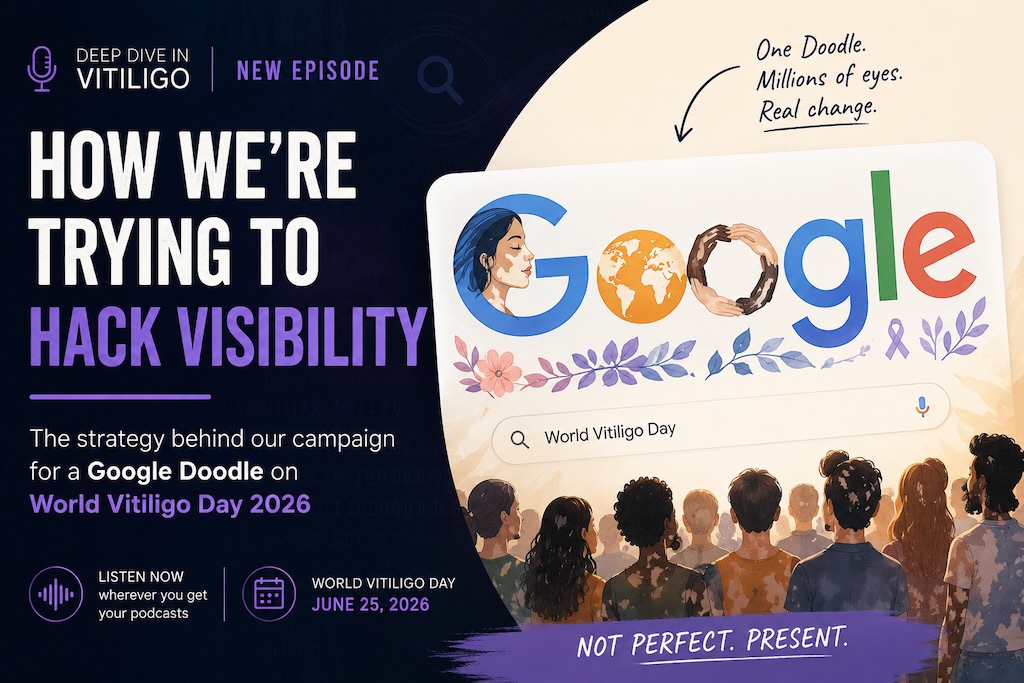
Google Doodle For World Vitiligo Day 2026 (Ep. 59)
What does a Google Doodle have to do with vitiligo? Potentially, quite a lot.
A Google Doodle won’t cure a disease. It won’t fund research. It won’t replace a dermatologist.
But for one day, it could introduce millions of people to a condition affecting nearly 100 million worldwide.
In our latest Deep Dive in Vitiligo podcast episode, we explore the campaign to bring a Google Doodle to #WorldVitiligoDay and why the strategy has evolved from traditional petitions to something much more suited to the age of algorithms.
It’s a story about visibility, technology, advocacy, and how patient communities are learning to speak the language of modern platforms.
🎙️ Listen to Deep Dive in Vitiligo
You can listen to Deep Dive in Vitiligo on your favorite podcast platform:
🍎 Apple Podcasts
🟢 Spotify
📦 Amazon Music
❤️ iHeart Radio
🎧 Player FM
🎙️ Podchaser
🎤 Podbean
Pick your platform, hit subscribe, and we'll meet you there.
FAQOther Questions
- I have a new job - should I tell colleagues about my vitiligo?
Starting a new job can be both exciting and nerve-wracking, — especially if you’re concerned about stares or questions regarding your skin. Taking a proactive approach can help ...
- Who is prone to vitiligo?
Vitiligo can affect anyone, regardless of gender, age, or race. Vitiligo prevalence is between 0.76% and 1.11% of the U.S. population, including around 40% of those with the con...
- I have vitiligo: will my children have vitiligo, too?
If you have vitiligo, it’s natural to worry about your children. While there is a genetic component, vitiligo is not a straightforward hereditary disease like eye color or heigh...
Though it is not always easy to treat vitiligo, there is much to be gained by clearly understanding the diagnosis, the future implications, treatment options and their outcomes.
Many people deal with vitiligo while remaining in the public eye, maintaining a positive outlook, and having a successful career.
Copyright (C) Bodolóczki JúliaBy taking a little time to fill in the anonymous questionnaire, you can help researchers better understand and fight vitiligo.